(✍ENGLISH text below the French text)
L’UNESCO inscrit les Caravansérails Iraniens sur la Liste du Patrimoine Mondial
Le 17 septembre 2023, lors de la 45e session du Comité du Patrimoine Mondial de l’UNESCO(1), réunie à Riyad en Arabie Saoudite, une évaluation méticuleuse a été menée, aboutissant à la sélection de 54 caravansérails Historiques situés dans 24 provinces à travers l’Iran. Comme indiqué dans la documentation, ces caravansérails sont l’une des manifestations architecturales les plus vitaux de l’Histoire Iranienne/Persane. Ils ont joué un rôle central dans le développement des itinéraires et des besoins liés aux voyages au fil des siècles. Cela souligne la créativité et le génie des architectes iraniens à travers l’histoire.
La conception et la structure distincte des caravansérails iraniens se démarquent. Il semble que de nombreux autres types de caravansérails dans le monde antique aient pu être inspirés par les modèles iraniens originaux.
La plupart des caravansérails suivent un plan quadrangulaire. L’entrée est généralement une grande porte ornée qui mène à une cour centrale. Autour de cette cour se trouvent des chambres et des étals pour les marchands, les voyageurs et leurs animaux. Bien qu’il existe un format architectural standard, de nombreux caravansérails différents par leurs conceptions en fonction de la région et de l’époque à laquelle ils ont été construits et des besoins spécifiques des voyageurs.
Des quantités de petits caravansérails ont aussi été construits à des intervalles de 20 à 30 kilomètres, ce qui correspond à peu près à la distance qu’une caravane peut parcourir en une journée. Ils servaient de refuges contre les bandits et fournissaient l’abri nécessaire contre les conditions climatiques difficiles.
L’Histoire
Il y a plus de 7 000 ans, c’est-à-dire vers la fin de l’âge de pierre au cours du néolithique(2), le vaste territoire d’Asie Central, peuplée par des tribus Indo-Iraniennes unifiées en tant que peuple *Aryen, avait déjà commencé à commercer entre eux. Le commerce depuis le plateau Iranien s’étendait à la Chine à l’est, à l’Asie Mineure et à la Mésopotamie à l’ouest à la vallée de l’Indus au sud, sur une distance est-ouest de près de dix mille kilomètres.
L’usage du commerce était du troc bien avant que la monnaie existe. Depuis la préhistoire, l’échange de biens ou de services entre individus était une pratique courante partout ou les premiers Hommes se sont installés.
En effet, les Aryens ont commencé à commercer très tôt dans leurs développements et les pierres et métaux précieux tels que le lapis-lazuli, les rubis, les émeraudes, le cristal de montagne, l’or et l’argent, qu’ils ont trouvé enfouis dans la terre et les montagnes, ont été des grandes opportunités pour des échanges de haute valeur, c’est ce qui a permis au peuple Aryen d’être une référence incontournable pour des commandes de pierres précieuses.
Des relais primaires furent bâtis aux abords des trajets. À cette époque ces trajets de routes furent connus comme « Commerce Aryen ».
L’essor des constructions des caravansérails, fut pendant l’Empire Iranien Achéménide, plus connu comme l’Empire Perse. C’est aussi à cette même époque que l’invention du système postal(3) prendra forme.
Renommé « Routes Royales » par Hérodote (Histoires 5.52-54) qui nous donne son récit des routes de l’Empire Perse. Hérodote connaissait bien les routes royales qu’il avait parcourues et qui allaient de la Lydie aux frontières de l’Ionie et de la Grèce jusqu’à Suse en Perse. Ces routes traversaient l’Arménie, le Tigre et Babylone.
Toujours selon Hérodote, il nous informe « des stations royales existent sur toute sa longueur, et d’excellents caravansérails; et partout, il traverse une étendue habitée et est exempt de danger. La route était bien entretenue, gardée et parcourue par un service régulier de messagerie et de poste ». Hérodote parle des courriers: « personne ne voyage aussi vite que ces messagers Persans », rajoutant: l’ensemble du plan postal est une invention Persane.
En effet, c’est à Cyrus le Grand, fondateur de la dynastie des Achéménides, régnant de 559 à 530 av. J.-C. et à son administration que l’on doit la mise en place de l’un des premiers systèmes étatiques de transmission des informations, réservé aux correspondances de l’État.
Le système de messagers fut connu sous le nom de Chapar Khaneh en persan, qui veut dire « Maison du Courrier », on peut encore les voir dans tout le pays.
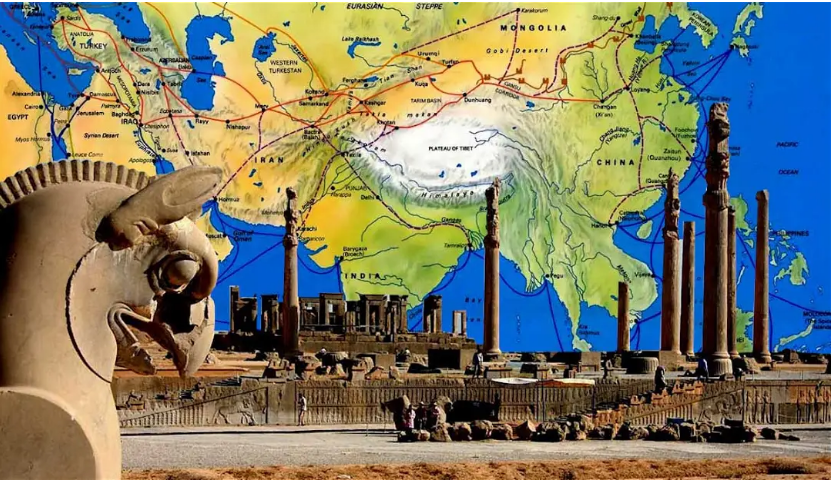
Historiquement, ces routes constituaient un réseau complexe de voies commerciales terrestres et maritimes, dont de nombreux caravansérails sont devenus des centres économiques animés, accueillant des marchés et facilitant le commerce. Et les emplacements de ces caravansérails pendant des siècles furent l’épicentre de grands changements culturels, d’idiologies et de religions, propagé aux quatre coins du monde par des mercenaires et des voyageurs lors des traverser des routes. Ses routes ont connecté les civilisations et mis en contact les peuples et les cultures du monde antique.
(Note importante, ce n’est qu’au milieu du 19e siècle dont le géologue allemand, le Baron Ferdinand von Richthofen, qui cherchait un terme plus exotique pour désigner ce réseau de commerce et de communication d’où transitaient au Moyen Âge soieries et autres marchandises de luxe, qu’il baptisera ce réseau « Die Seidenstrasse » « La Route de la Soie(4) », et est depuis restée).
Il y aura un rebond de construction des caravansérails pendant l’invasion des musulmans du Grand Iran, les caravansérails seront construits avec une mosquée intérieure. C’est aussi pendant le règne des Safavide (1501-1722) que l’Iran a vu un coup de pouce significatif dans la construction de nouveaux caravansérails, principalement pour promouvoir le commerce et faciliter la circulation des biens et des personnes à travers l’empire.
De nombreux caravansérails ont été restaurés et transformés en hôtels, musées ou centres culturels pour préserver leur riche histoire. Ils servent d’attractions touristiques populaires.
À suivre, (Liste complète des caravansérails en Iran)
À suivre, (Comment le mot *Aryen fut falsifié par des imposteurs de tous bords)
-Photo: Ancient Silk Road Trade
Beginnings of the Silk Road in Antiquity: The Royal Road of Persia (Blog en anglais, veuillez utiliser la traduction)
https://www.thecollector.com/silk-road-ancient-world/
(1)
-Le caravansérail persan – UNESCO
Les caravansérails étaient des relais situés au bord des routes offrant un abri, de la nourriture et de l’eau aux caravanes, aux pèlerins et aux autres voyageurs. Les routes et les emplacements des caravansérails étaient déterminés par la présence de ressources en eau, les caractéristiques géographiques et les questions de sécurité. Les cinquante-six caravansérails de ce bien ne représentent qu’un petit nombre des nombreux caravansérails construits sur les anciennes routes d’Iran. Ils sont considérés comme les exemples les plus influents et opulents d’Iran, présentant un large éventail de styles architecturaux, de modes, d’adaptation aux conditions climatiques et de matériaux de construction, répartis sur des milliers de kilomètres et construits sur plusieurs siècles. Ensemble, ils illustrent l’évolution et le réseau des caravansérails en Iran à différentes périodes de l’histoire.
https://whc.unesco.org/fr/list/1668/
-Le complexe d’Izadkhast – UNESCO
Ce complexe historique a été situé sur une base naturelle avec des caractéristiques uniques. Le complexe contient le château d’Izadkhast, un caravansérail et le pont de la période safavide. Les œuvres à l’intérieur du château appartiennent à différentes périodes, des Sassanides aux Qajars. La section la plus importante du complexe est le château qui a été construit sur un substrat rocheux singulier dans une construction de sable et à proximité de la vallée d’Izadkhast. Le socle rocheux a protégé le château des attaques des étrangers. Un pont et une porte dans la partie la plus accessible du complexe permettaient de se connecter avec les zones environnantes. La petitesse de la roche a conduit à l’agglomération de salles construites. Par conséquent, la petitesse des pièces a entraîné une augmentation des étages.
https://whc.unesco.org/fr/listesindicatives/5205/
(2)
-Ancien commerce aryen (Blog en anglais, veuillez utiliser la traduction)
Les Aryens ont commencé à commercer entre eux dans les terres étendues formées par leurs migrations très tôt dans leur histoire, et il existe des preuves de leur commerce au cours du néolithique (nouveau) âge de pierre, c’est-à-dire vers la fin de l’âge de pierre il y a environ 7 000 ans.
http://www.heritageinstitute.com/zoroastrianism/aryans/trade.htm
-LES FIGURINES HUMAINES ET ANIMALES DU SITE NÉOLITHIQUE DE GANJ DAREH (IRAN)
https://www.jstor.org/stable/41492478
-Le Néolithique en Iran : où en sommes-nous aujourd’hui ?
https://archeorient.hypotheses.org/4061
-Du Néolithique à l’Empire achéménide
http://www.teheran.ir/spip.php?article2355#gsc.tab=0
-Chasse et élevage au nord du Plateau central iranien entre le Néolithique et l’Âge du Fer [article]
https://www.persee.fr/doc/paleo_0153-9345_2002_num_28_1_4737
-La circulation des matières précieuses et les grandes voies commerciales au Proche-Orient du Néolithique au 2e millénaire avant notre ère
La partie occidentale de ce qui deviendra plus tard les Routes de la soie a très tôt été l’objet d’échanges de produits à longue distance. Ainsi, dès le Néolithique précéramique, vers 9 000 avant notre ère, l’obsidienne transitait dans tout le Proche-Orient sur des centaines de kilomètres. La recherche de matériaux rares ou précieux comme les métaux (or, argent, cuivre, étain) ou certaines pierres semi-précieuses (lapis-lazuli, cornaline, chlorite) ont également conduit ensuite, aux 5e-3e millénaires avant notre ère notamment, à la mise en place de routes commerciales s’étendant des monts du Pamir à l’est jusqu’à la côte méditerranéenne à l’ouest. À ces matières premières, il faut ajouter le commerce de denrées transformées comme le vin ou l’huile d’olive, ou manufacturées comme le verre, dont on peut suivre la diffusion jusqu’en Europe occidentale.
https://journals.openedition.org/chrhc/17254
-Iran, 9000-4000 av. J.-C. Le néolithique (Blog en anglais, veuillez utiliser la traduction)
https://www.penn.museum/sites/expedition/iran-9000-4000-b-c/
(3)
-La poste Perse
Cyrus II dit Cyrus le grand (559 à 529 av. JC.), fondateur de l’empire Perse est connu pour être à l’origine des relais de Poste appelés angaréion. Hérodote dans son « Histoire », livre huit-98, Uranie, écrit :
« pendant ces préparatifs, Xerxès dépêcha un courrier en Perse pour y porter la nouvelle de son malheur actuel. Rien de si efficace parmi les mortels que ces courriers. Voici le système qu’ont inventé les Perses ».
http://histoirepostale.com/histoire/la_poste_perse.html
-La poste aux chevaux
https://www.museedelaposte.fr/fr/system/files/fp_la_poste_aux_chevaux.pdf
(4)
-ROUTES DE LA SOIE
Mentionnée pour la première fois dans un ouvrage d’un géographe allemand du XIXe siècle, Ferdinand von Richthofen, la « Route de la soie » n’a jamais été connue sous ce nom par les marchands qui la parcouraient.
Peut-être ne savaient-ils même pas que les pistes qu’ils empruntaient faisaient partie d’une route fabuleuse, véritable pont entre l’Orient et l’Occident pendant près d’un millénaire, permettant l’échange de produits prestigieux et d’idées nouvelles.
https://www.universalis.fr/encyclopedie/routes-de-la-soie/
✍ENGLISH
UNESCO inscribes Iran’s Caravanserais in the World Heritage List
On September 17, 2023, at the 45th session of UNESCO’s(1) World Heritage Committee, meeting in Riyadh, Saudi Arabia, a meticulous evaluation was carried out, resulting in the selection of 54 Historic Caravanserais located in 24 provinces across Iran.
As noted in the documentation, these caravanserais are one of the most vital architectural manifestations of Iranian/Persian History. They have played a central role in the development of travel routes and needs over the centuries.
The distinctive design and structure of Iranian caravanserais stand out. It seems that many other types of caravanserai in the ancient world have been inspired by the original Iranian models.
Most caravanserais follow a quadrangular plan. The entrance is usually a large, ornate doorway leading to a central courtyard. Around this courtyard are rooms and stalls for merchants, travelers and their animals.
Although there is a standard architectural format, many caravanserais differ in design depending on the region and period in which they were built, and the specific needs of the travelers.
Many small caravanserais were also built at intervals of 20 to 30 kilometers, roughly the distance a caravan could travel in a day. They served as refuges against bandits and provided the necessary shelter against harsh weather conditions.
The History
More than 7,000 years ago, towards the end of the Stone Age during the Neolithic(2), the vast territory of Central Asia, populated by Indo-Iranian tribes unified as the *Aryan people, had already begun trading with each other.
Trade from the Iranian plateau extended to China in the east, Asia Minor and Mesopotamia in the west, and the Indus valley in the south, over an east-west distance of almost ten thousand kilometers.
The practice of trade was bartering long before money existed. Since prehistoric times, the exchange of goods or services between individuals has been a common practice wherever the first humans settled.
Indeed, the Aryans began trading very early in their development, and precious stones and metals such as lapis lazuli, rubies, emeralds, mountain crystal, gold and silver, which they found buried in the earth and mountains, were great opportunities for high-value trade, and this is what enabled the Aryan people to be a leading reference for gemstone orders. Primary relays were built along the routes. At the time, these routes were known as « Aryan trade ».
The boom in caravanserai construction took place during the Iranian Achaemenid Empire, better known as the Persian Empire. It was also during this period that the invention of the postal(3) system took shape.
Renamed « Royal Roads » by Herodotus (Histories 5.52-54), who gives us his account of the roads of the Persian Empire. Herodotus was well acquainted with the royal roads he had traveled from Lydia on the borders of Ionia and Greece to Susa in Persia. These routes crossed Armenia, the Tigris and Babylon. Also, according to Herodotus, he informs us « royal stations exist along its length, and excellent caravanserais; and everywhere it crosses an inhabited expanse and has no danger. The road was well maintained, guarded and traversed by a regular courier and mail service ».
Herodotus speaks of the couriers: « no one travels as fast as these Persian messengers », adding: the whole postal system is a Persian invention.
Indeed, it was Cyrus the Great, founder of the Achaemenid dynasty, who reigned from 559 to 530 BC, and his administration, who set up one of the first state information transmission systems, reserved for state correspondence.
The messenger system was known as « Chapar Khaneh » in Persian, meaning the « house of courier », they can still be seen throughout the country.
Historically, these routes formed a complex network of trade routes by land and sea, with many caravanserais becoming bustling economic centers, hosting markets and facilitating trade. And the locations of these caravanserais for centuries were the epicenter of great cultural changes, idiologies and religions, spread to the four corners of the world by mercenaries and travelers crossing these roads. These roads have connected civilizations and brought together the peoples and cultures of the ancient world.
(Important note, it wasn’t until the mid-19th century that the German geologist Baron Ferdinand von Richthofen came up with a exotic term for this trade and communication network, through which silks and other luxury goods transited in the Middle Ages. He, then, dubbed this network « Die Seidenstrasse » « The Silk Road(4) », and it has remained so ever since).
There would be a rebound in caravanserai construction during the Muslim invasion of Greater Iran, new caravanserais are built with an interior mosque. It was also during the Safavid reign (1501-1722) that Iran saw a significant boost in the construction of new caravanserais, mainly to promote trade and facilitate the movement of goods and people across the empire.
Many caravanserais have been restored and transformed into hotels, museums or cultural centers to preserve their rich history. They serve as popular tourist attractions.
To be continued, (Complete list of caravanserais in Iran)
To be continued, (How the word *Aryan was falsified by impostors)
-Photo: Ancient Silk Road Trade
Beginnings of the Silk Road in Antiquity: The Royal Road of Persia
https://www.thecollector.com/silk-road-ancient-world/
(1)
-The Persian Caravanserai – UNESCO
Caravanserais were roadside inns, providing shelter, food and water for caravans, pilgrims and other travellers. The routes and the locations of the caravanserais were determined by the presence of water, geographical conditions and security concerns. The fifty-six caravanserais of the property are only a small percentage of the numerous caravanserais built along the ancient roads of Iran. They are considered to be the most influential and valuable examples of the caravanserais of Iran, revealing a wide range of architectural styles, adaptation to climatic conditions, and construction materials, spread across thousands of kilometres and built over many centuries. Together, they showcase the evolution and network of caravanserais in Iran, in different historical stages.
https://whc.unesco.org/en/list/1668/
-The Complex of Izadkhast – UNESCO
This historical complex has been situated on a natural base along with unique characteristics. The complex contains the castle of Izadkhast, one caravanserai and the Safavid-period bridge. The works inside of the castle belong to different periods from Sassanids to Qajars. The most important section of the complex is the castle that has been built on singular bedrock in a sand construction and close to the valley of Izadkhast. The bedrock has protected the castle from the foreigners’ attacks. A bridge and a gate in the most accessible part of the complex made it possible to connect with the surrounding areas. The smallness of the rock led to agglomeration of built rooms. Hence, the smallness of rooms resulted in increase of floors.
https://whc.unesco.org/en/tentativelists/5205/
(2)
-Ancient Aryan Trade
The Aryans started trading between themselves in the expanded lands formed by their migrations very early in their history, and there is evidence of their trade during the Neolithic (new) Stone Ages, that is, towards the end of the Stone Age some 7,000 years ago.
http://www.heritageinstitute.com/zoroastrianism/aryans/trade.htm
-The Archaeology of Iran from the Palaeolithic to the Achaemenid Empire
https://www.taylorfrancis.com/books/oa-mono/10.4324/9781003224129/archaeology-iran-palaeolithic-achaemenid-empire-roger-matthews-hassan-fazeli-nashli
-Worship of the mother gods from the Neolithic period in Iran, Tiba Sarab, 7000-6100, before history
https://jcoart.uobaghdad.edu.iq/index.php/2075-3047/article/view/617
-Domesticating Iran: the Neolithic period, 10,000–5200 BC
https://www.taylorfrancis.com/chapters/oa-mono/10.4324/9781003224129-5/domesticating-iran-neolithic-period-10-000%E2%80%935200-bc-roger-matthews-hassan-fazeli-nashli
-The western part of what would later become the Silk Roads was very early traded for products over long distances. Thus, from the pre-ceramic Neolithic around 9000 BC, obsidian traveled throughout the Middle East for hundreds of kilometers. The search for rare or precious materials such as metals (gold, silver, copper, tin) or semi-precious stones (lapis lazuli, carnelian, chlorite) also led then, during the 5th-3rd millennia BC in particular, to the establishment of trade routes stretching from the Pamirs in the east to the Mediterranean coast in the west. To these raw materials must be added the trade in processed food, such as wine or olive oil or manufactured, such as glass, the distribution of which can be traced to Western Europe.
https://journals.openedition.org/chrhc/17254?lang=en
-IRAN, 9000-4000 B.C. The Neolithic
https://www.penn.museum/sites/expedition/iran-9000-4000-b-c/
-PRECIOUS GEMS OF THE SILK ROUTES
https://sandrine-martin.com/wp-content/uploads/Precious-Gems-of-the-Silk-Routes-2018-Sandrine-Martin.pdf
(3)
-The Foundation of Iran’s Postal System and the Issue of the First Stamps
It is said that the ancient Persians of the Achaemenid Empire were the first who established a well-disciplined system that transported written documents across their vast country.
The system was based on courier (or relay) stations (called the Chapar-Khaneh), where a message carrier (called the Chapar) would be assigned with a mail dispatch. He would ride with the mail to the next station, where his horse would be swapped for a fresh one; thus reaching his destination at the shortest possible time.
Herodotus praised the Persian couriers by stating: « they are stayed neither by snow nor rain nor heat nor darkness from accomplishing their appointed course with all speed ». This verse, though slightly rephrased, prominently features on New York’s James Farley Post Office: “Neither snow nor rain nor heat nor gloom of night stays these couriers from the swift completion of their appointed rounds.”
http://farahbakhsh.com/IranStampHistoryEn/IranStampHistory.html
(4)
Ferdinand von Richthofen is noted for coining the terms “Seidenstraße” and “Seidenstraßen” = “Silk Road(s)” or “Silk Route(s)” in 1877, which denominates the ancient network of trade routes that were for centuries central to cultural interaction through regions of the Asian continent connecting the East and West and stretching from the Korean peninsula and Japan to the Mediterranean Sea.
http://scihi.org/ferdinand-freiherr-von-richthofen-silk-road/#:~:text=Ferdinand%20von%20Richthofen%20is%20noted,the%20East%20and%20West%20and
─────
IranPersiaVoyage
─────
 Iran Persia Voyage