Mithra en Suisse / Mithra in Switzerland
SUJETS
-Mithra en Suisse
-Comment un culte Iranien a atteint l’Occident ?
-La Suisse Avant
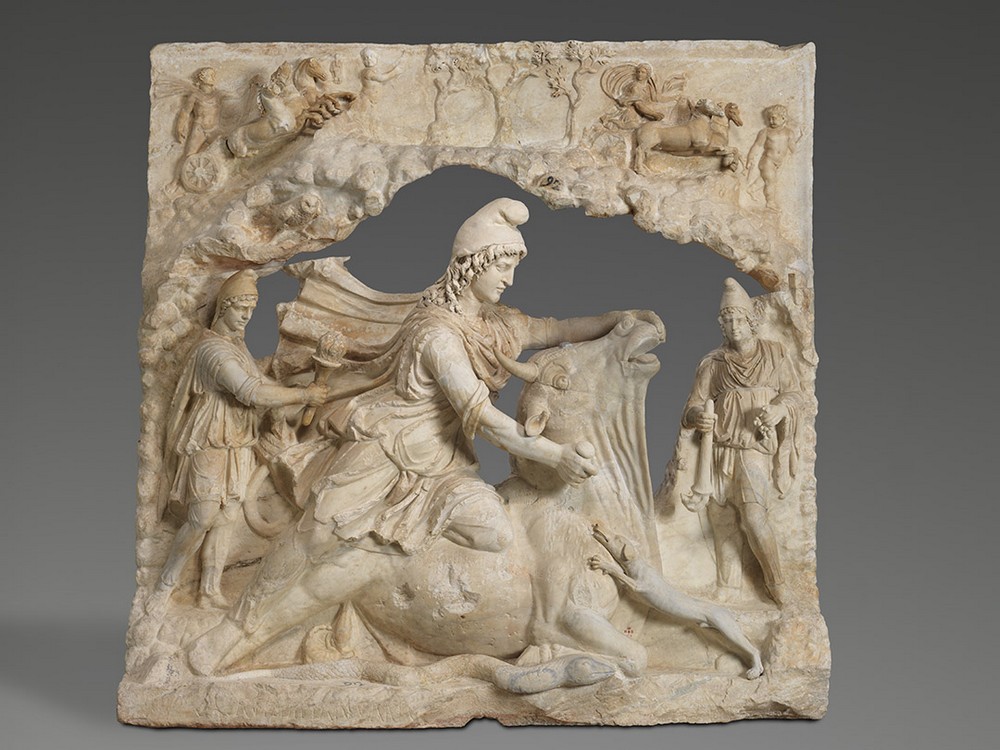
-Relief représentant Mithra, dieu iranien du Soleil, sacrifiant le taureau, Vers 100-200 après J.-C.
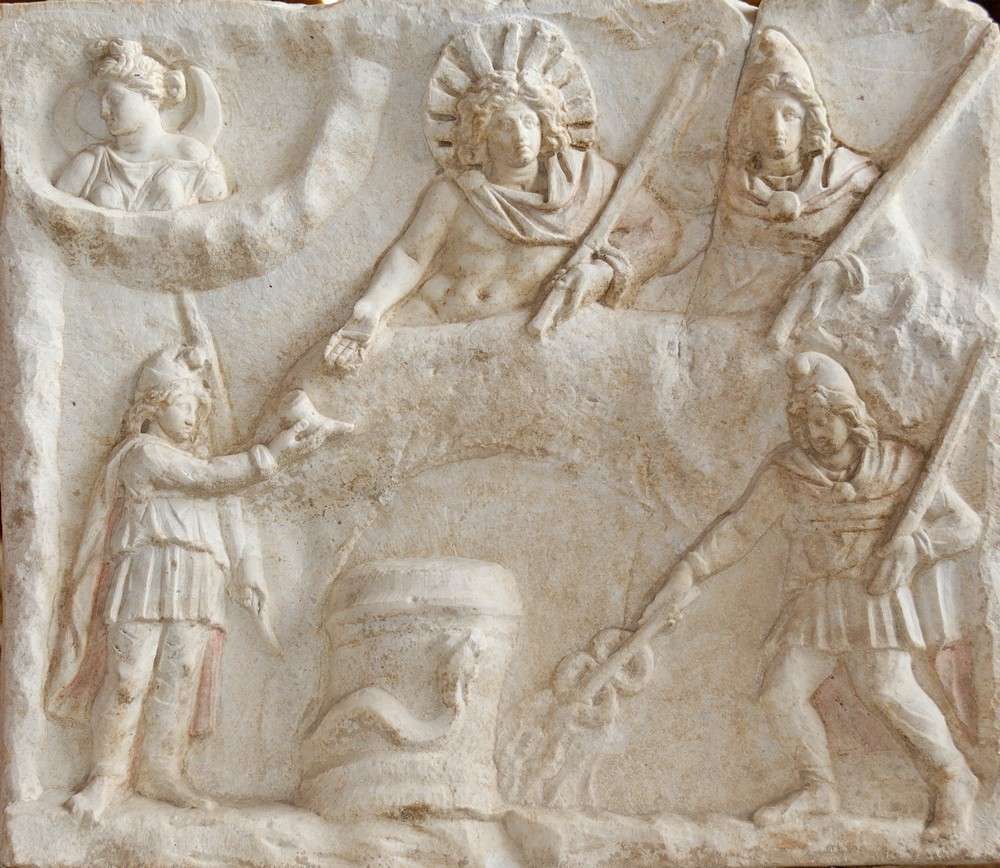
-Mithras banquet
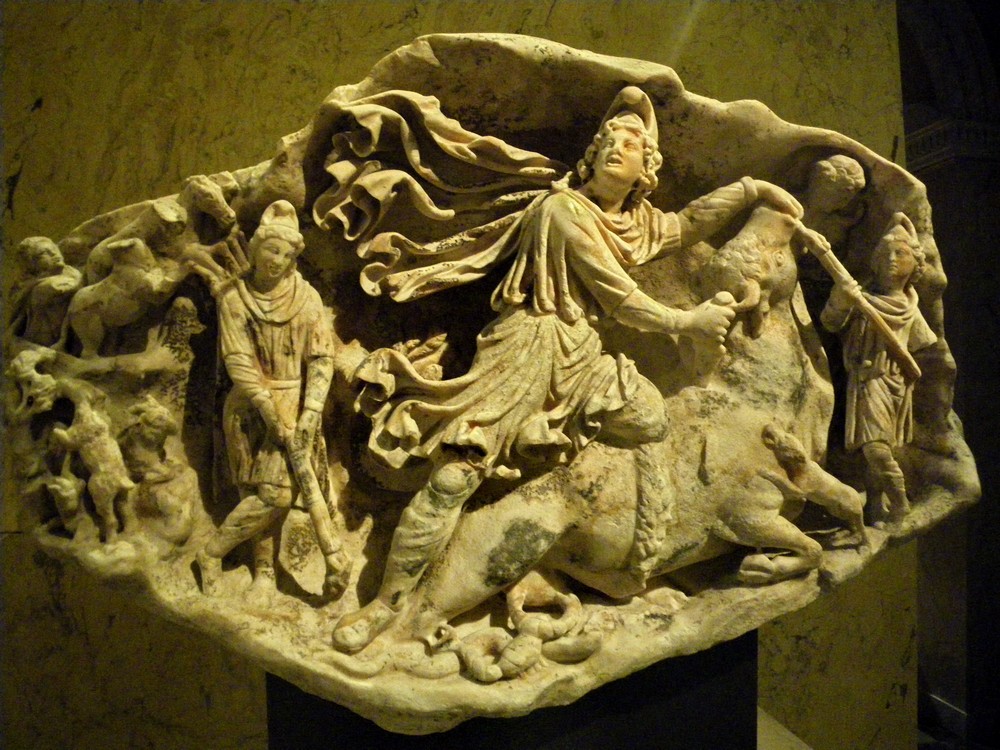
-La Tauroctonie
-Antiochus de Commagène et Mithra
-Shapur I Valérian Bas Relief à Naghsh-e Rostam, Shiraz, Iran
-Ariamanus, l’esprit maléfique de la religion mithriaque
-Mithradate VI, l’énigmatique Roi empoisonné
-Champignons, mythe et Mithra: Le culte de la drogue qui a civilisé l’Europe
(✍ENGLISH below the French text)
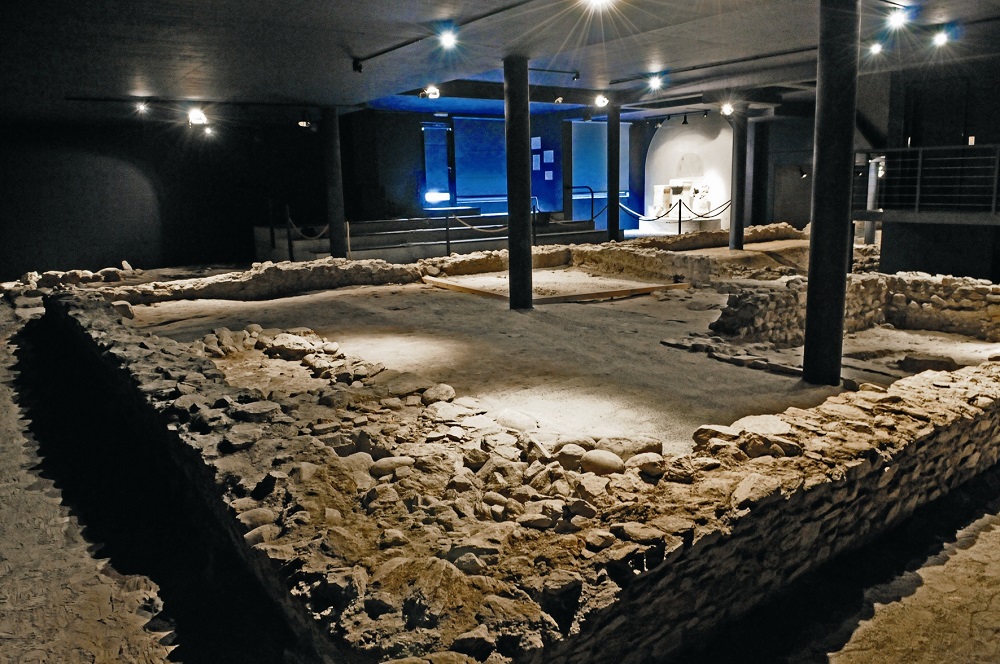
En Suisse, un sanctuaire de Mithra, Dieu Solaire d’origine Iranienne, édifié entre 150 et 200 après J. -C., a été découvert dans le canton de Martigny en 1993.
La religion de Mithra remonte à plus de 2’000 av. J. -C., et est issue du culte iranien Mehr qui a émergé dans la chaîne du Zagros, cette chaîne de hautes montagnes sépare le Plateau iranien de la plaine Mésopotamienne.
En persan « Mehr » veut dire « Soleil », nom qui provient de la langue avestique et du vieux perse, divinité solaire la plus importante des anciens peuples indo-iraniens, en sanskrit il est Mitra.
C’est à l’occasion de la construction d’un nouvel immeuble que la découverte du sanctuaire a été faite et d’innombrables objets furent aussi découverts.
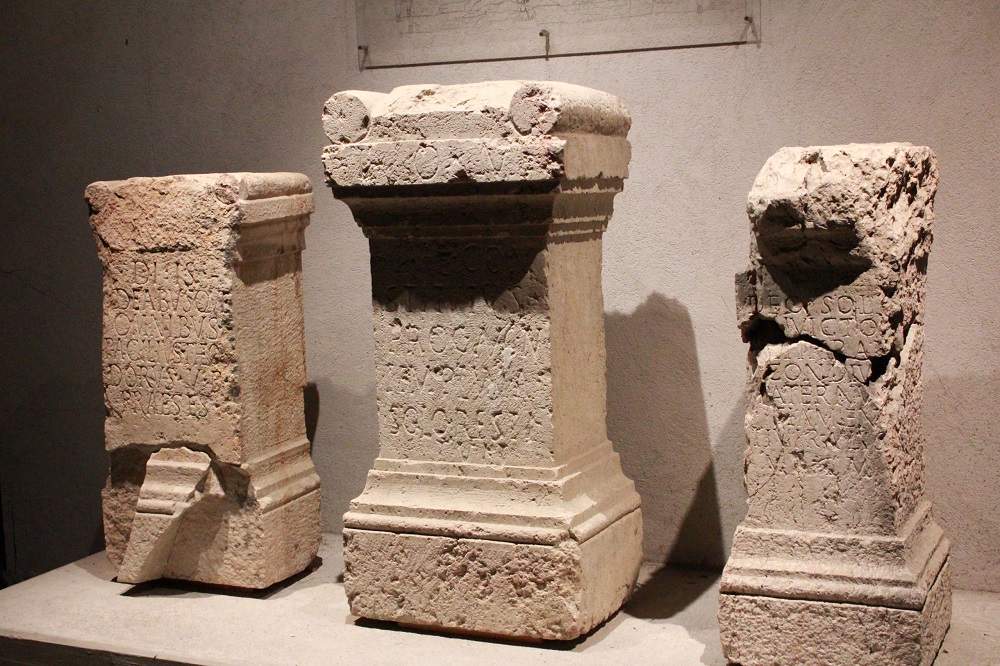
L’architecture du sanctuaire se composait de trois autels en pierre. Parmi les objets trouvés, des figurines en bronze relevant le sacrifice d’un taureau (la *tauroctonie), témoigne l’usage de cet endroit pour Mithra.
La datation du sanctuaire, a été fait selon les nombreux objets votifs découverts (plus de 2000 monnaies, des fragments de cristal de roche et des récipients en terre cuite), et les constats archéologiques, que le mithraeum a été édifié vraisemblablement entre 150 et 200 après. J. -C.
Le sanctuaire de Mithra fût détruit en deux phases par les premiers Chrétiens occidentaux dès le début du 5e siècle de notre ère.
En effet, avec l’émergence de la nouvelle religion du christianisme en Occident, les lieux dédiés à Mithra seront systématiquement détruits par les premiers Chrétiens devenus hostiles à Mithra, dont ils ont pourtant vénéré pendant des siècles.
Les similitudes entre Mithra qui précède de 600 ans du Christ étaient tells, qu’il fallait effacer la présence de Mithra. Des églises seront mêmes bâties par-dessus des lieux de culte de Mithra.
De nombreux vestiges de ce culte ont été trouvés en Grande-Bretagne, en Italie, en Roumanie, en Allemagne, en Autriche, en Bulgarie, en Turquie, en Arménie, en Syrie, en Israël et en France (Bordeaux, Bourg Saint Andéol dans l’Ardèche, en Alsace, Metz, et ailleurs).
Mithra a été représenté en Occident comme un jeune homme vêtu d’une tunique, avec un bonnet persan *phrygien sur la tête, tuant un taureau.
Les cérémonies des Mystères se déroulaient soit dans des grottes, soit dans des caves – le plus important était d’effectuer des rituels dans une pièce fermée et isolée de la lumière.
Le rituel était suivi par des hommes qui subissaient des étapes ultérieures d’initiation, un processus en sept étapes.
L’ensemble du rituel était fortement associé à l’astrologie et conduisait à surmonter les vices humains, à libérer l’âme et à retourner dans le monde idéal de l’éternité et de la permanence.
(Il est important de préciser, ce n’est pas parce qu’il y a des similitudes entre Mithra et le Christ, que le Christ n’a pas existé. L’histoire est bien plus complexe.
Par exemple: on trouve bien des similitudes dans les religions monothéismes dont la religion iranienne du Zoroastrisme est considérée être la première religion Monothéisme, prônant en un Seul Dieu, suivit du Judaïsme, Christianisme et l’Islam.
Mais malgré ses similitudes, chacune de ses religions s’est forgé ses propres spécifiés indépendamment des unes aux autres et cela par des personnages historiques qui ont existé. (L’un n’empêche pas l’autre).
De plus est, l’imbrication des vieux cultes aux nouveaux cultes ou de veilles cultures en nouvelles cultures, n’a rien de nouveau, c’est ainsi partout depuis la nuit de temps).
(À suivre, comment un culte Iranien a atteint l’Occident ?)
ARTICLE ORIGINAL
-En Suisse, sanctuaire de Mithra, Dieu solaire d’origine Iranienne, édifié entre 150 et 200 apr. J.-C
D’innombrables objets furent découverts, ce qui, outre son architecture, fait de ce monument l’un des mieux documenté du monde romain : trois autels en pierre, des monnaies, des figurines en bronze relevant de l’image sacrée du sacrifice d’un taureau (la tauroctonie), etc.
Les nombreux objets votifs découverts (plus de 2000 monnaies, des fragments de cristal de roche, des récipients en terre cuite, etc.) et les constats archéologiques indiquent que le mithraeum, édifié vraisemblablement entre 150 et 200 apr. J.-C., fut détruit en deux phases par les premiers chrétiens dès le début du Ve s.
2 Photos et Texte: https://www.martigny.com/fr/activity/mithraeum-5395/
ARTICLE ORIGINAL
-Mithraeum (fin IIe-IVe s. après J.-C.)
A l’occasion de la construction d’un immeuble, à quelque 50 m au nord de la Fondation Pierre Gianadda, les archéologues ont découvert un sanctuaire consacré au dieu solaire d’origine iranienne Mithra.
Il s’agit du seul sanctuaire de Mithra ouvert au public sur sol suisse.
Non loin du téménos, également en périphérie méridionale de la ville romaine, un mithraeum fut édifié vraisemblablement à la fin du IIe s. de notre ère. Il a été découvert en 1993 à l’occasion de la construction d’un immeuble et a pu être conservé dans son sous-sol, à la place des caves projetées.
Grâce à l’enthousiasme de Léonard Gianadda, le sanctuaire dédié à Mithra a pu être fouillé complètement et surtout conservé in situ. D’innombrables objets furent découverts, ce qui, outre son architecture, fait de ce monument un des mieux documenté du monde romain : trois autels en pierre, des monnaies, des figurines en bronze relevant de l’image sacrée (la tauroctonie), etc.
Le mithraeum a des dimensions de l’ordre de 23,36 m sur 8,95 m et devait avoir une apparence austère car ses façades n’étaient apparemment percées d’aucune fenêtre. Il se composait d’un hall d’entrée presque carré auquel on accédait par une porte latérale. On y trouvait des foyers sur lesquels on cuisait des aliments.
Une sacristie, l’apparatorium, était réservée dans un de ses angles. Du hall, on accédait dans le saint des saints du sanctuaire, le spelaeum en descendant trois marches. Cette salle, longue de 14,40m était bordée de deux banquettes sur lesquelles s’allongeaient obliquement les initiés pour participer notamment à des repas sacramentels. Au fond du spelaeum se trouvait un podium précédé de quelques marches sur lequel étaient disposés des autels à offrandes consacrés par des personnages importants de la cité. Le tout était dominé par l’image de la tauroctonie, représentation rituelle, toujours la même, figurant le dieu Soleil invincible Mithra tuant le taureau blanc en lui enfonçant un poignard au défaut de l’épaule.
A Martigny, fait exceptionnel, cette tauroctonie était composée d’éléments en bronze disparates. Les nombreux objets votifs découverts (plus de 2000 monnaies, des fragments de cristal de roche, des récipients en terre cuite, etc.) et les constats archéologiques indiquent que le mithraeum, édifié vraisemblablement entre 150 et 200 apr. J.-C., fut détruit en deux phases par les premiers chrétiens dès le début du Ve s.
D’après François Wiblé, Martigny-la-Romaine, 2008, p. 146-160.
Texte: https://www.gianadda.ch/a_decouvrir_aussi/martigny-la-romaine/mithraeum/
2 Photos: https://www.martigny.com/fr/activity/mithraeum-5395/
Pour en savoir plus
-MYTHE PERSE MITHRA – « Lève-toi, Soleil, aux chevaux rapides »
Monté sur son char attelé à des chevaux blancs, Mithra est associé au Soleil et apparaît comme l’esprit du bien et l’ordonnateur du monde. Dieu aux milles oreilles et aux dix milles yeux, son regard embrase l’Univers et rien ne lui échappe.
Son parcours annuel était considéré comme une illustration cosmique de la destinée humaine : naissance, vie, mort et résurrection.
« La lumière qui voit tout est l’emblème de la vérité, et c’est surtout comme témoin universel que Mithra est devenu l’incarnation céleste de la conscience et de la vérité.» (Darmsteter, Zend Avesta, II, 141, 142)
http://cosmobranche.free.fr/MythesSoleil.htm
(Lien en anglais)
-LES MYSTÈRES DE MITHRA – LES ORIGINES DU MITHRAÏSME
À cette époque inconnue, où les ancêtres des Perses étaient encore unis à ceux des Hindous, ils adoraient déjà Mithra. Les hymnes des Védas célébraient son nom, ainsi que ceux de l’Avesta, et malgré les différences qui s’établissaient entre les deux systèmes théologiques dont ces livres étaient l’expression, la Mitra védique et le Mithra iranien ont conservé tant de traits de ressemblance qu’il est impossible de douter de leur origine commune.
https://sacred-texts.com/cla/mom/mom04.htm
*La tauroctonie est assurément l’iconographie la plus répandue et la plus connue du culte de Mithra; elle se déroule à l’équinoxe de printemps.
Après la capture et le transport (transitus) du taureau, Mithra se rend dans une grotte où il sacrifie celui-ci après qu’un corbeau, messager du Soleil, le lui ait signifié.
https://hal.science/hal-02143904/document
*Le bonnet phrygien est un bonnet conique souple à l’apex courbé.
Ce qui a été appelé le bonnet phrygien était à l’origine utilisé par plusieurs peuples iraniens, dont les Sakas, Scythes, les Mèdes et les Perses.
La plus ancienne représentation du bonnet phrygien provient de Persépolis en Iran.
D’après les rapports des Grecs anciens, il semble que la variante iranienne du bonnet phrygien était également une coiffe molle appelée diadème.
Des anciennes gravures démontrent que la classe supérieure Mède portait de hauts diadèmes à crête.
Tous semblent avoir été faits d’un matériau doux avec de longs rabats sur les oreilles et le cou, mais la forme du haut varie.
(Lien en anglais)
-COURONNE i. À l’époque mède et achéménide
Dans l’ancienne Perse, la couronne se présentait sous diverses formes. Le terme vieux persan pour une telle coiffe n’est pas conservé, bien qu’il ait été suggéré que divers termes grecs contemporains – par exemple, kídaris ou kítaris, tiára et kurbasía – étaient dérivés du persan ou d’autres langues orientales (Pauly-Wissowa, XI/1, col. 378-79 ; Suppl. XIV, col. 786-96). Les auteurs anciens ne distinguent pas toujours clairement ces termes, et la preuve la plus fiable des formes des couronnes perses est donc les représentations sur les monuments achéménides.
https://www.iranicaonline.org/articles/crown-i#prettyPhoto
︵‿︵‿︵‿︵‿︵‿︵‿︵‿︵‿︵‿︵‿︵
✍ENGLISH
TOPICS
-Mithra in Switzerland
-How did an Iranian cult reach the West?
-Switzerland Before
-Relief representing Mithra, Persian sun god, sacrificing the bull. Marble. Rome, Italy, 100 – 200 AD
-Mithras banquet
-The Tauroctony
-Antiochus of Commagene and Mithra
-Shapur I Valerian Bas Relief at Naghsh-e Rostam, Shiraz, Iran
-Ariamanus: The Evil Spirit of Mithraic Religion
-Mithridates VI, the enigmatic poison King
-Mushrooms, Myth and Mithras: The Drug Cult that Civilized Europe
Mithra in Switzerland
In Switzerland, a sanctuary of Mithra, the Iranian Sun God, built between 150 and 200 A.D., was discovered in the canton of Martigny in 1993.
The religion of Mithra dates back to over 2,000 BC, and originates from the Iranian Mehr cult that emerged in the Zagros mountain range, which separates the Iranian plateau from the Mesopotamian plain.
In Persian, « Mehr » means « Sun », a name derived from the Avestic language and Old Persian, the most important solar deity of the ancient Indo-Iranian peoples; in Sanskrit it’s Mitra.
It was during the construction of a new building that the sanctuary was discovered, and countless artifacts were also unearthed.
The sanctuary’s architecture consisted of three stone altars. Among the objects found were bronze figurines depicting the sacrifice of a bull (*tauroctony), testifying to the use of this place for Mithras.
The sanctuary was dated on the basis of the many votive objects discovered (over 2,000 coins, rock crystal fragments and terracotta vessels), and archaeological findings that the mithraeum was probably built between 150 and 200 AD.
The sanctuary of Mithra was destroyed in two phases by the first Western Christians in the early 5th century AD.
Indeed, with the emergence of the new religion of Christianity in the West, places dedicated to Mithras were systematically destroyed by the early Christians, who had become hostile to Mithras, even though they had worshipped him for centuries.
The similarities between Mithra, who pre-dates Christ by 600 years, were such that Mithra’s presence had to be erased. Churches were even built over Mithra’s places of worship.
Numerous relics of this cult have been found in Britain, Italy, Romania, Germany, Austria, Bulgaria, Turkey, Armenia, Syria, Israel and France (Bordeaux, Bourg Saint Andéol in the Ardèche, Alsace, Metz and elsewhere).
Mithra was depicted in the West as a young man dressed in a tunic, with a Persian *phrygian cap on his head, killing a bull.
Mystery ceremonies took place either in caves or cellars – the most important thing was to perform rituals in a closed room, isolated from the light.
The ritual was followed by men who underwent subsequent stages of initiation, a seven-step process.
The whole ritual was strongly associated with astrology and led to overcoming human vices, freeing the soul and returning to the ideal world of eternity and permanence.
(It’s important to point out, that just because there are similarities between Mithras and Christ, it doesn’t mean that Christ didn’t exist. The story is far more complex.
For example, there are many similarities between monotheistic religions, of which the Iranian religion of Zoroastrianism is considered to be the first, advocating one God, followed by Judaism, Christianity and Islam.
But despite their similarities, each of these religions has forged its own specificity independently of the others, and this through historical figures who actually existed. (One doesn’t rule out the other).
Furthermore, the interweaving of old cults with new cults, or of old cultures with new cultures, is nothing new; it’s been the case everywhere since the dawn of time).
(To be continued, how did an Iranian cult reach the West?)
ORIGINAL ARTICLE
-In Switzerland, Sanctuary of Mithra, Sun God of Iranian origin, built between 150 and 200 AD
Countless objects were discovered, which, in addition to its architecture, makes this monument one of the best documented in the Roman world: three stone altars, coins, bronze figurines of the sacred image of the sacrifice of a bull (the tauroctonie), etc.
The numerous votive objects discovered (more than 2000 coins, fragments of rock crystal, terracotta vessels, etc.) and archaeological findings indicate that the mithraeum, probably built between 150 and 200 AD, was destroyed in two phases by the first Christians at the beginning of the fifth century.e s.
2 Photos and Text: https://www.martigny.com/fr/activity/mithraeum-5395/
ORIGINAL ARTICLE
-Mithraeum (late II)e-IVe s. A.D.)
On the occasion of the construction of a building, some 50 m north of the Pierre Gianadda Foundation, archaeologists discovered a sanctuary dedicated to the sun god of Iranian origin Mithras.
It is the only sanctuary of Mithras open to the public on Swiss soil.
Not far from Temenos, also on the southern outskirts of the Roman city, a mithraeum was probably built at the end of the second century.e s. of our era. It was discovered in 1993 during the construction of a building and could be kept in its basement, instead of the projected cellars.
Thanks to the enthusiasm of Leonardo Gianadda, the sanctuary dedicated to Mithras was able to be excavated completely and especially preserved in situ. Countless objects were discovered, which, in addition to its architecture, makes this monument one of the best documented in the Roman world: three stone altars, coins, bronze figurines of the sacred image (the tauroctonia), etc.
The mithraeum has dimensions of the order of 23.36 m by 8.95 m and must have had an austere appearance because its facades were apparently not pierced by any windows. It consisted of an almost square entrance hall which was accessed through a side door. There were hearths on which food was cooked.
A sacristy, the apparatorium, was reserved in one of its corners. From the hall, one reached the holy of holies of the sanctuary, the spelaeum by descending three steps. This room, 14.40m long, was bordered by two benches on which the initiates lay obliquely to participate in sacramental meals. At the end of the spelaeum was a podium preceded by a few steps on which were arranged altars with offerings consecrated by important figures of the city. The whole was dominated by the image of the tauroctonia, ritual representation, always the same, representing the invincible Sun god Mithra killing the white bull by driving a dagger into the defect of the shoulder.
In Martigny, exceptionally, this bullfighting was composed of disparate bronze elements. The numerous votive objects discovered (more than 2000 coins, fragments of rock crystal, terracotta vessels, etc.) and archaeological findings indicate that the mithraeum, probably built between 150 and 200 AD, was destroyed in two phases by the first Christians at the beginning of the fifth century.e s.
Text: https://www.gianadda.ch/a_decouvrir_aussi/martigny-la-romaine/mithraeum/
2 Photos: https://www.martigny.com/fr/activity/mithraeum-5395/
To know more
-MITHRA AND THE SUN – MITHRA AS THE SUN: THE SOLARITY QUESTION OF THE GOD MITHRA IN IRANIAN RELIGIOUS HISTORY FROM THE POINT OF VIEW OF COMPARATIVE RELIGIOUS STUDIES
https://associationforiranianstudies.org/content/mithra-and-sun-%E2%80%93-mithra-sun-solarity-question-god-mithra-iranian-religious-history-point-vie
-THE MYSTERIES OF MITHRA – THE ORIGINS OF MITHRAISM
IN THAT unknown epoch when the ancestors of the Persians were still united with those of the Hindus, they were already worshippers of Mithra. The hymns of the Vedas celebrated his name, as did those of the Avesta, and despite the differences obtaining between the two theological systems of which these books were the expression, the Vedic Mitra and the Iranian Mithra have preserved so many traits of resemblance that it is impossible to entertain any doubt concerning their common origin.
https://sacred-texts.com/cla/mom/mom04.htm
*Tauroctony is a modern name given to the central cult reliefs of the Mithraic Mysteries in the Roman Empire.
The imagery depicts Mithras killing a bull, hence the name tauroctony after the Greek word tauroktonos (ταυροκτόνος, « bull killing »).
https://en.wikipedia.org/wiki/Tauroctony
*The Phrygian cap is a soft conical cap with a curved apex.
What has come to be known as the Phrygian cap was originally used by several Iranian peoples, including the Sakas, Scythians, Medes and Persians.
The oldest representation of the Phrygian cap comes from Persepolis in Iran.
From the reports of the ancient Greeks, it seems that the Iranian variant of the Phrygian cap was also a soft headdress called a diadem.
Ancient engravings show that the Mede upper class wore high crested tiaras.
All appear to have been made from a soft material with long flaps over the ears and neck, but the shape of the top varies.
-CROWN i. In the Median and Achaemenid periods
In ancient Persia the crown occurred in a variety of forms. The Old Persian term for such a headdress is not preserved, though it has been suggested that various contemporary Greek terms—for example, kídaris or kítaris, tiára, and kurbasía—were derived from Persian or other eastern languages (Pauly-Wissowa, XI/1, cols. 378-79; Suppl. XIV, cols. 786-96). The ancient authors do not always distinguish clearly among these terms, and the most reliable evidence for the forms of Persian crowns is thus the depictions on Achaemenid monuments.
https://www.iranicaonline.org/articles/crown-i#prettyPhoto
─────
Comment un culte Iranien a atteint l’Occident ?
(✍ENGLISH below the French text) How did an Iranian cult reach the West?
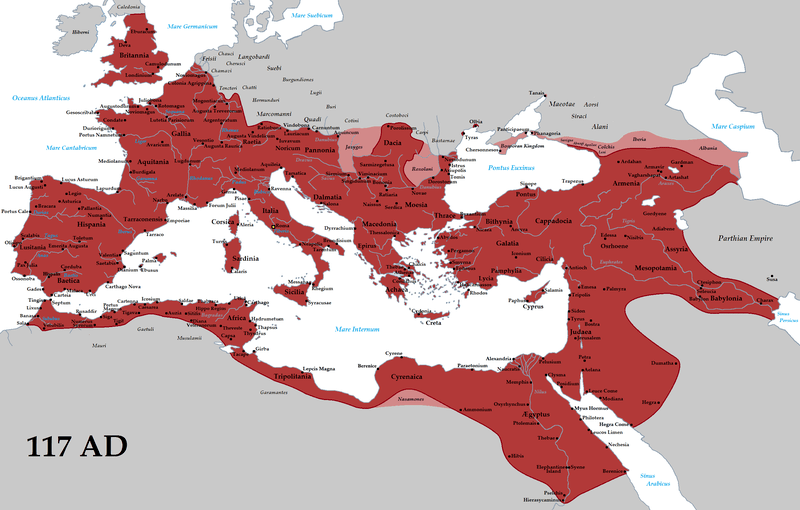
Photo:
L’Empire romain (rouge) et ses vassaux (rose) en 117 après. J.-C. pendant le règne de l’empereur Trajan.
https://fr.wikipedia.org/wiki/Empire_romain
Selon les ancient récits, on sait que les soldats d’Alexandre de Macédoine au cours de leurs invasions de l’Iran/Perse en 336 av. J. -C. connurent le culte de Mithra, les Grecs dès lors identifièrent Mithra à Hélios, Dieu grec du Soleil, contribuant ainsi à répandre le culte de Mithra dans l’Asie Mineure.
Mais ça sera surtout les Romains, par leurs nombreuses colonies en Asie Mineure et de longues années de fréquentations avec l’Iran/Perse, relation tantôt amicale et tantôt rivale, qui seront les plus fervents au Mithraïsme.
Ainsi, Mithra prit de l’essor surtout parmi les soldats et les marchant romains.
Les raisons de la popularité du culte de Mithra parmi ces deux groupes se comprennent par le caractère martial pour les soldats avec des notions telles que la vérité, l’honneur, le courage et la fraternité.
Et pour la classe marchande le caractère le « Dieu des contrats ».
Mithra avait deux fonctions importantes, il était d’abord et avant tout le Dieu-Soleil dont les milliers d’yeux épiaient chaque action en particulier les mauvaises actions, rien ne pouvait échapper à son regard.
Et deuxièmement, il était le Dieu des contrats.
Une rupture de promesse ou de contrat été un grave crime, considéré par les préceptes de Mithra comme la perfidie classée comme l’un des crimes les plus odieux et les coupables étaient punis sévèrement.
Il n’est donc pas déraisonnable de penser que les marchands romains préféraient faire des affaires avec ceux en qui ils pouvaient avoir confiance et que leurs conversions en masse à Mithra servaient surtout à cimenter les liens entre eux.
En tout cas, les récits confirment que ce sont les soldats romains se déplaçant constamment à travers leur vaste Empire, qu’ils sont devenus des fervents missionnaires de Mithra, propageant son culte partout.
Mithra était aussi populaire auprès des légionnaires romains.
Ainsi, le culte de Mithra se répandit non seulement dans tout l’Empire Romain mais partout aussi où des légions romaines étaient stationnées: de l’Espagne à la Mer noire en montant vers l’Écosse dans le nord et en descendant jusqu’au Sahara.
Les Romains vénéraient plusieurs cultes et l’un des plus importants fut le Dieu Saturne, célébré entre le 17 et le 23 décembre.
Et Mithra que les Romains nommaient « Deus Sol Invictus » (Soleil Invaincu), fut probablement célébré le 11 décembre mais d’autres dates seront aussi citées.
La popularité de Mithra sera telle, que la première congrégation fut créée à Rome, vers 68 av. J. -C., par des soldats adulateurs de Mithra, sous la direction du Général Pompée.
Son premier siège de culte se trouvait dans le sous-sol de l’actuelle basilique Saint-Clément à Rome, Italie.
Mithra fit son entrée dans la littérature latine vers l’an 80 apr. J. -C. par le poète Statius.
L’empereur romain Commode (161-192 apr. J. -C.) lui-même fut initié au culte de Mithra, et sous le règne d’Aurélien (270-275 apr. J.-C.) le Mithraïsme fut proclamé religion officielle de l’Empire Romain et l’empereur l’incarnation terrestre du Soleil.
Progressivement par la montée du Christianisme en Occident, le culte de Mithra à Rome sera mis à mal.
Dans le même intervalle, lorsque Constantin 1er (v. 274-337 apr. J. -C.) se convertit au Christianisme en 312 apr. J.-C., le Mithraïsme perdit de son influence.
Outre, entre-temps en 324 apr. J. -C., Constantin le Grand va interdire le culte des rituels sanglants du sacrifice du taureau mais qui fut seulement appliqué en 341 apr. J. -C.
Et en 354 apr. J. -C., le pape Liberius désigne officiellement le 25 décembre comme fête de la naissance du Christ.
Sous Julien dit l’Apostat (331-363 apr. J.-C.), Mithra fera un bref rebond avant d’être complètement absorbé par le Christianisme.
En effet, durant la Christianisation de l’Empire Romain, la célébration de la naissance de Jésus de Nazareth le 25 décembre a progressivement remplacé le culte de Mithra Sol Invictus.
À noter, qu’avant le changement de date de la naissance du Christ par le pape Tibère, les chrétiens fêtaient la naissance du Christ le même jour que l’Épiphanie, le 6 janvier.
Avec l’émergence du christianisme en Occident, les lieux dédiés à Mithra seront détruits par les premiers Chrétiens devenus hostiles à Mithra, dont ils ont pourtant vénéré.
Petit à petit les pratiquants du mithraïsme seront accusés de blasphèmes et de satanismes. Tout sera fait pour liquider le culte de Mithra.
Les récits ci-dessus sont focalisés sur les événements impliquant le mithraïsme à Rome, parce qu’il y aurait bien plus à dire sur l’histoire de Mithra.
(Il est important de préciser, ce n’est pas parce qu’il y a des similitudes entre Mithra et le Christ, que le Christ n’a pas existé. L’histoire est bien plus complexe.
Par exemple: on trouve bien des similitudes dans les religions monothéismes dont la religion iranienne du Zoroastrisme est considérée être la première religion Monothéisme, prônant en un Seul Dieu, suivit du Judaïsme, Christianisme et l’Islam.
Mais malgré ses similitudes, chacune de ses religions s’est forgé ses propres spécifiés indépendamment des unes aux autres et cela par des personnages historiques qui ont existé. (L’un n’empêche pas l’autre).
De plus est, l’imbrication des vieux cultes aux nouveaux cultes ou de veilles cultures en nouvelles cultures, n’a rien de nouveau, c’est ainsi partout depuis la nuit de temps).
Les liens dans le texte ci-dessus
-Les conquêtes d’Alexandre le Grand
-Hélios
-De la naissance à la chute de l’empire romain
-Saturne
-La basilique Saint-Clément-du-Latran (en italien : Basilica di San Clemente al Laterano) est située à Rome et dédiée au pape saint Clément Ier. Sur le site se trouve un complexe de bâtiments sur plusieurs niveaux, dont trois sont dégagés : le niveau archéologique inférieur date de l’empire romain, avec un mithraeum dédié à Mithra et un autre bâtiment ; au-dessus, une église du ve siècle, détruite par les Normands ; enfin l’église actuelle construite par-dessus cette dernière, peu avant l’an 1100 au cours du haut Moyen Âge.
-Stace (Publius Papinius Statius) est un poète de langue latine de la Rome antique.
-Commode
-Aurélien
-Le christianisme conquiert l’empereur Constantin
-Libérius
-Julien (empereur romain)
-Tibère
-Épiphanie : d’où vient la tradition de la galette des rois ?
Pour en savoir plus
-L’empire perse, l’ennemi oriental qui a fait trembler Rome
La dynastie des Sassanides a restauré la Perse dans sa splendeur impériale en s’inspirant de ses puissants ancêtres. Elle régnait sur des terres qui s’étendaient de la Turquie jusqu’au Pakistan. Lorsqu’Alexandre le Grand conquit la Perse en 331 av. J.-C., il mit un terme à l’Empire achéménide, fondé par Cyrus le Grand. Pendant les cinq siècles qui suivirent, le plateau iranien fut placé sous le joug d’autres empires, jusqu’à la montée au pouvoir d’une nouvelle dynastie perse. Extrêmement fiers de leurs racines, ces nouveaux rois, appelés les Sassanides, restaurèrent la grandeur de leurs ancêtres, en faisant appel à leur passé pour devenir des conquérants inspirant la crainte, des grands bâtisseurs et des mécènes des arts.
https://www.nationalgeographic.fr/histoire/2020/10/lempire-perse-lennemi-oriental-qui-a-fait-trembler-rome
-Mithra est le dieu perse du soleil levant, des contrats, des pactes et de l’amitié. Il supervisait également le changement ordonné des saisons, maintenait l’ordre cosmique et était responsable de l’octroi de la grâce divine aux rois, légitimant ainsi leur règne.
En tant que protecteur des fidèles, il était également invoqué par les guerriers avant la bataille et devint ainsi un dieu de la guerre.
https://www.worldhistory.org/trans/fr/1-10029/mithra/
-MITHRA À ROME
Mithra est un dieu d’origine indo-iranienne. Son nom – mitra en védique, langue religieuse ancienne de l’Inde – signifie « ami », « contrat ».
https://odysseum.eduscol.education.fr/mithra-rome
-Lors de travaux de restauration et de mise en sécurité de la Domus dei Capitelli di Stucco dans le parc archéologique d’Ostia Antica, les archéologues ont mis à jour une rare représentation du dieu Mithra.
https://lepetitjournal.com/vivre-a-rome/decouverte-dun-rare-relief-ostia-antica-331700
-À la découverte du culte romain de Mithra
https://www.universitairestichting.be/sites/default/files/2022-03-08_talk-fu_mithra_light.pdf
-L’apparition et la diffusion du culte de Mithra à l’époque romaine
La première mention du culte de Mithra qui concerne l’occident et l’empire romain est issue de l’œuvre de Plutarque.
Dans ses Vies parallèles, et dans le chapitre consacré à Pompée (XXIV, 7), Plutarque explique que c’est au contact des pirates de Cilicie, lors de la guerre qu’a mené Pompée contre ces derniers en 66 av. J.-C., que les romains découvrent Mithra et ses mystères.
https://leg8.fr/religion/culte-de-mithra/
︵‿︵‿︵‿︵‿︵‿︵‿︵‿︵‿︵‿︵‿︵
✍ENGLISH
How did an Iranian cult reach the West?
Photo Map
Roman_Empire_Trajan_117AD
https://en.wikipedia.org/wiki/Roman_Empire
According to ancient accounts, the soldiers of Alexander of Macedon, during their invasions of Iran/Persia in 336 BC, came into contact with the cult of Mithra, and the Greeks identified Mithra with Helios, the Greek God of the Sun, thus helping to spread the cult of Mithra throughout Asia Minor.
But it was above all the Romans, through their numerous colonies in Asia Minor and long years of contact with Iran/Persia, a relationship that was sometimes friendly and sometimes rivalrous, who were the most fervent supporters of Mithraism.
In this way, Mithra grew in popularity, especially among Roman soldiers and merchants.
The reasons for the popularity of the cult of Mithras among these two groups can be understood by the martial character for soldiers with notions such as truth, honor, courage and brotherhood.
And for the merchant class, character is the « God of contracts ».
Mithra had two important functions: first and foremost, he was the Sun-God, whose thousands of eyes spied on every action, especially evil deeds; nothing could escape his gaze.
And secondly, he was the God of contracts.
Breaking a promise or contract was a serious crime, considered by Mithra’s precepts to be perfidy, classified as one of the most odious crimes, and the guilty were severely punished.
So it’s not unreasonable to think that Roman merchants preferred to do business with those they could trust, and that their mass conversions to Mithras served above all to cement the bonds between them.
Whatever the case, the stories confirm that it was Roman soldiers, constantly on the move across their vast Empire, who became fervent missionaries of Mithras, spreading his cult everywhere.
Mithra was also popular among Roman legionnaires.
Thus, the cult of Mithras spread not only throughout the Roman Empire, but wherever Roman legions were stationed: from Spain to the Black Sea, up to Scotland in the north and down to the Sahara.
The Romans worshipped several cults, one of the most important being the God Saturn, celebrated between December 17 and 23.
And Mithra, whom the Romans called « Deus Sol Invictus » (Unconquered Sun), was probably celebrated on December 11, but other dates will also be cited.
Such was Mithra’s popularity that the first congregation was founded in Rome, around 68 BC, by Mithra-worshipping soldiers under the leadership of General Pompey.
His first place of worship was in the basement of today’s Basilica of St. Clement in Rome, Italy.
Mithra made his entry into Latin literature around AD 80, through the poet Statius.
The Roman emperor Commodus (161-192 AD) himself was initiated into the cult of Mithras, and under the reign of Aurelian (270-275 AD) Mithraism was proclaimed the official religion of the Roman Empire and the emperor the earthly incarnation of the Sun.
Gradually, with the rise of Christianity in the West, the cult of Mithras in Rome came under attack.
In the meantime, when Constantine I (c. 274-337 AD) converted to Christianity in 312 AD, Mithraism lost its influence.
Meanwhile, in 324 AD, Constantine the Great forbade the worship of bloody bull sacrifice rituals, but this was only enforced in 341 AD.
And in 354 AD, Pope Liberius officially designated December 25 as the feast of Christ’s birth.
Under Julian the Apostate (AD 331-363), Mithras briefly rebounded before being completely absorbed by Christianity.
Indeed, during the Christianization of the Roman Empire, the celebration of the birth of Jesus of Nazareth on December 25 gradually replaced the cult of Mithra Sol Invictus.
It is worth noting, before Pope Tiberius changed the date of Christ’s birth, Christians celebrated the birth of Christ on the same day as Epiphany, January 6.
With the emergence of Christianity in the West, places dedicated to Mithras were destroyed by early Christians who had become hostile to Mithras, even though they worshipped him.
Little by little, followers of Mithraism were accused of blasphemy and Satanism. Everything would be done to liquidate the cult of Mithra.
The above accounts focus on events involving Mithraism in Rome, because there is much more to be said about the history of Mithra.
(It’s important to point out, that just because there are similarities between Mithras and Christ, it doesn’t mean that Christ didn’t exist. The story is far more complex.
For example, there are many similarities between monotheistic religions, of which the Iranian religion of Zoroastrianism is considered to be the first, advocating one God, followed by Judaism, Christianity and Islam.
But despite their similarities, each of these religions has forged its own specificity independently of the others, and this through historical figures who actually existed. (One doesn’t rule out the other).
Furthermore, the interweaving of old cults with new cults, or of old cultures with new cultures, is nothing new; it’s been the case everywhere since the dawn of time).
The links in the above text
-The conquests of Alexander the Great
-Helios
-From the Founding of Rome to the Downfall of the Empire
-Saturn: Roman God of Agriculture
-San Clemente al Laterano
The Basilica of Saint Clement (Italian: Basilica di San Clemente al Laterano) is a Latin Catholic minor basilica dedicated to Pope Clement I located in Rome, Italy. Archaeologically speaking, the structure is a three-tiered complex of buildings: the present basilica built just before the year 1100 during the height of the Middle Ages; beneath the present basilica is a 4th-century basilica that had been converted out of the home of a Roman nobleman, part of which had in the 1st century briefly served as an early church, and the basement of which had in the 2nd century briefly served as a mithraeum; the home of the Roman nobleman had been built on the foundations of republican era villa and warehouse that had been destroyed in the Great Fire of AD 64.
-Statius
-Commodus
-Aurelian
-Constantine’s Conversion to Christianity
-Pope Liberius
-Julian the Apostate
-Tiberius
-What is Epiphany and why do we celebrate it?
To know more
-A reborn Persian Empire captured Rome’s lands—and its emperor
Inspired by their powerful ancestors, the Sassanian dynasty restored Persia to imperial glory, ruling lands that stretched from Turkey to Pakistan.
Alexander the Great conquered Persia in 331 B.C. and ended the Achaemenid Empire founded by Cyrus the Great. For the next five centuries, the Iranian plateau became ruled by other empires, until a new Persian dynasty took power. Fiercely proud of their roots, these new kings—the Sassanians—restored the might of their ancestors, drawing on their past to become feared conquerors, grand builders, and artistic patrons.
https://www.nationalgeographic.com/history/history-magazine/article/reborn-persian-empire-captured-rome-emperor
-MITRA-MITHRA-MITHRAS: THE ROMAN MITHRAS AND HIS INDO-IRANIAN BACKGROUND
https://go.gale.com/ps/i.do?id=GALE%7CA600270058&sid=googleScholar&v=2.1&it=r&linkaccess=abs&issn=00445975&p=AONE&sw=w
-The Mithreaum of Lugo reveals the expansion of the Persian cult to the boundaries of Hispania
The museum that houses the temple of Mithras has become the most visited Roman space in the city since it opened.
https://www.mithraeum.eu/notitia/the-mithreaum-of-lugo-reveals-the-expansion-of-the-persian-cult-to-the-boundaries-of-hispania-20210105
-Mithraism, also known as the Mithraic mysteries, was a Roman mystery religion centered on the god Mithras. The religion was inspired by Iranian worship of the Zoroastrian god Mithra.
https://digitalmapsoftheancientworld.com/mythology/roman-mythology/eastern-religions/mithras/
-Rome Mithraeum- Seven Of The Most Mysterious Underground Sites in Rome
https://passportsymphony.com/rome-mithraeum-temples/
-7 Best Rome Mithraeum Temples
https://myadventuresacrosstheworld.com/guide-to-rome-mithraeum-temples/
─────
La Suisse Avant
(✍ENGLISH below the French text) Switzerland Before
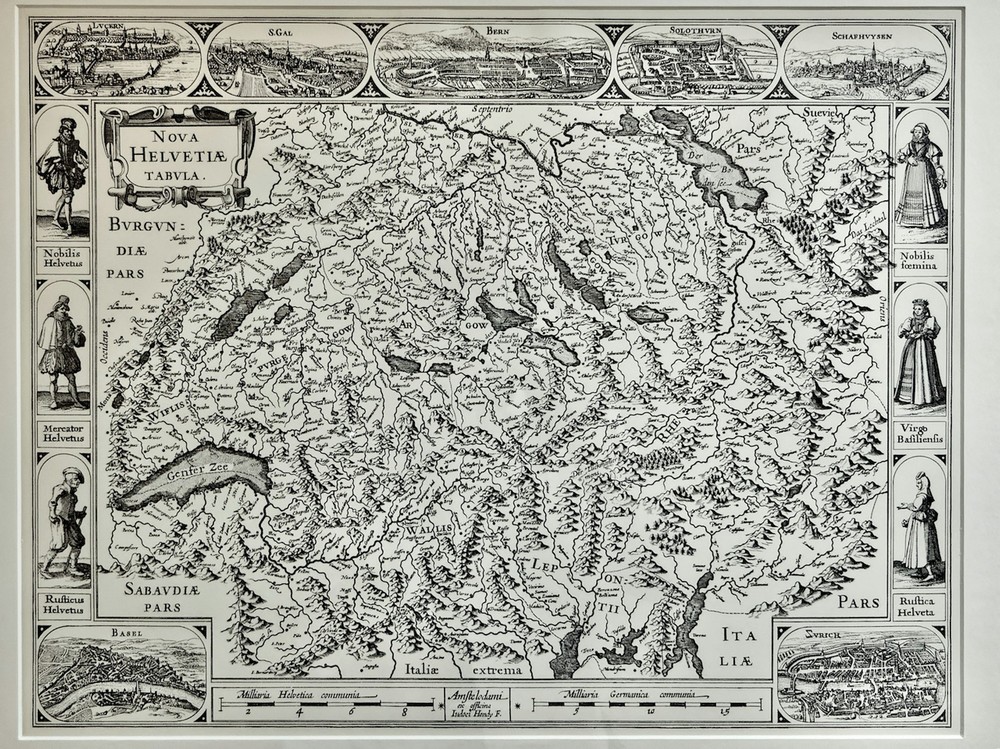
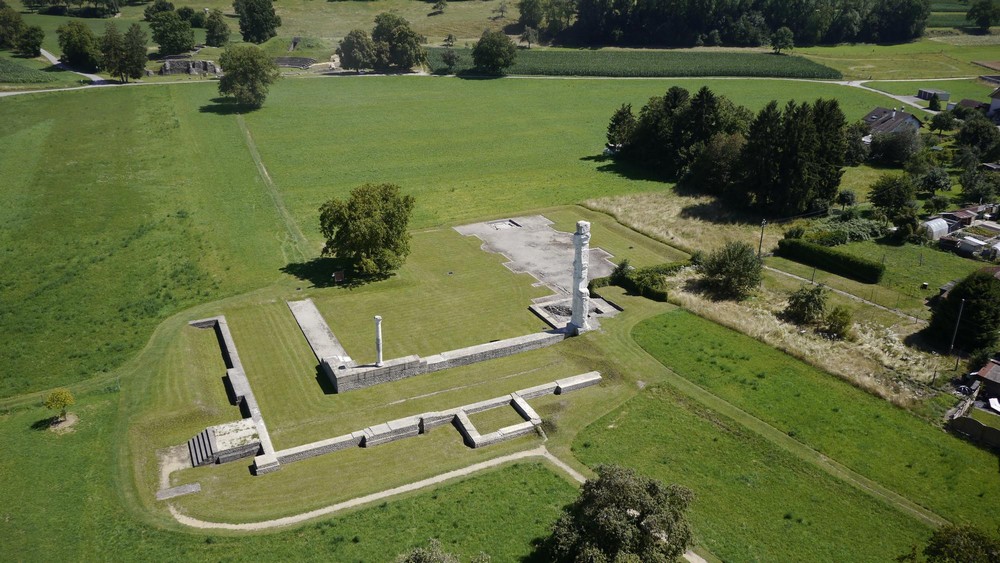
Photo:
Carte de l’Helvétie
https://notrehistoire.ch/entries/04YzA4jAWqK
Photo:
AVENTICUM – CAPITALE DE L’HELVÉTIE ROMAINE
Se divertir dans les arènes en assistant aux combats de gladiateurs, privilégier le bien-être et le prélassement aux thermes publics, ces us et coutumes faisaient partie du quotidien des habitants d’Aventicum, il y a 2000 ans. Elevée à la condition de colonie placée sous la protection de l’Empereur, la cité romanisée était la capitale du peuple des Helvètes et comptait alors 20 000 âmes. Son rayonnement s’exerçait loin à la ronde, du Nord au Sud des Alpes. Les témoignages de cette époque fastueuse et florissante sont encore visibles aujourd’hui, lors de la visite des vestiges des imposants monuments du Site romain et de l’impressionnante collection d’objets du Musée romain.
https://www.avenches.ch/fr/G2500/aventicum-capitale-de-l-helvetie-romaine?
-La Civilisation romaine en Helvétie
Selon la légende, Rome fut fondé en 753 avant J.C. Ce grand empire, à son apogée (le moment où l’empire est à son sommet) au IIe siècle, entoure toute la mer Méditerranée. La religion romaine comptait de nombreux dieux, inspirés en partie des dieux grecs.
À l’époque de Jules César, l’Empire romain envahit la Gaule de Vercingétorix, après le siège d’Alésia en -52.
L’Empire romain, dans sa partie occidentale s’effondre beaucoup plus tard, au moment des invasions germaniques, en 476, cette date marque la fin de l’Antiquité et le début du Moyen Âge. Mais sa partie orientale survivra pendant près de 1’000 ans dans l’Empire byzantin.
Le territoire de la Suisse actuelle a été progressivement intégré à l’empire romain entre le 1er siècle av. J.C. et le début du 1er siècle après J.C. La domination romaine s’est terminée en 401 après J.C., mais les structures romaines se sont maintenues dans certaines parties de la Suisse jusqu’au début du moyen âge.
https://wikivaud.ch/les-romains/
-LE CANTON DE VAUD AU TEMPS DES ROMAINS
https://www.myvaud.ch/fr/Z14340/le-canton-de-vaud-au-temps-des-romains?
-Jules César contre les Helvètes
https://valeur-suisse-institut.ch/jules-cesar-contre-les-helvetes/
-A Orbe, les plus belles mosaïques romaines de Suisse
https://www.pichonvoyageur.ch/a-orbe-les-plus-belles-mosaiques-romaines-de-suisse/
-De nouveaux vestiges Romains découverts dans les Alpes
Pour la première fois depuis près d’un siècle, une équipe d’archéologues a découvert des murs en pierre datant de l’Empire romain à Zoug, en Suisse. Dans un communiqué, l’Office pour la préservation des monuments et de l’archéologie qualifie cette découverte de « sensation archéologique » pour la région. De quoi offrir un meilleur aperçu de l’activité romaine dans le centre du pays.
https://sciencepost.fr/nouveaux-vestiges-romains-decouverts-alpes/
-Etat de Vaud – AVENTICUM – Site et Musée romains d’Avenches
https://www.aventicum.org/fr/
︵‿︵‿︵‿︵‿︵‿︵‿︵‿︵‿︵‿︵‿︵
✍ENGLISH
Switzerland Before
Photo:
Map of Helvetia
https://notrehistoire.ch/entries/04YzA4jAWqK
Photo:
AVENTICUM – CAPITAL OF ROMAN HELVETIA
The habits and customs of Aventicum’s inhabitants 2000 years ago included entertaining themselves at the arena by attending gladiator fights, taking time for their well-being, as well as basking and relaxing at the thermal baths. This Roman city was the capital of the Helvetii people, numbering 20,000 souls at the time; a settlement that rose to be a colony and was placed under the Emperor’s protection. Its influence and outreach extended far and wide, from the north to the south of the Alps. Evidence from this sumptuous and flourishing era are still visible today when visiting the Roman Site’s vestiges of its imposing monuments and the Roman Museum’s impressive collection of ancient objects.
https://www.avenches.ch/en/G2500/aventicum-capital-of-roman-helvetia?
-Roman Civilization in Helvetia
According to legend, Rome was founded in 753 B.C. This great empire, at its height (the moment when the empire is at its peak) in the IIand century, surrounds the entire Mediterranean Sea. The Roman religion had many gods, inspired in part by the Greek gods.
In the time of Julius Caesar, the Roman Empire invaded Vercingetorix’s Gaul, after the siege of Alesia in 52 BC.
The Roman Empire, in its western part, collapsed much later, at the time of the Germanic invasions, in 476, this date marks the end of Antiquity and the beginning of the Middle Ages. But its eastern part survived for almost 1,000 years in the Byzantine Empire.
The territory of present-day Switzerland was gradually integrated into the Roman Empire between the 1he century B.C. J.C. and the beginning of the 1he century A.D.. Roman rule ended in 401 A.D., but Roman structures continued in parts of Switzerland until the early Middle Ages.
-THE CANTON OF VAUD IN ROMAN TIMES
https://www.myvaud.ch/en/Z14340/the-canton-of-vaud-in-roman-times?
-Julius Caesar vs. the Helvetii
https://valeur-suisse-institut.ch/jules-cesar-contre-les-helvetes/
-In Orbe, the most beautiful Roman mosaics in Switzerland
https://www.pichonvoyageur.ch/a-orbe-les-plus-belles-mosaiques-romaines-de-suisse/
-New Roman remains discovered in the Alps
For the first time in nearly a century, a team of archaeologists has discovered stone walls dating back to the Roman Empire in Zug, Switzerland. In a statement, the Office for the Preservation of Monuments and Archaeology called the discovery an « archaeological sensation » for the region. This provides a better insight into Roman activity in the centre of the country.
https://sciencepost.fr/nouveaux-vestiges-romains-decouverts-alpes/
-State of Vaud – AVENTICUM – Roman site and museum of Avenches
https://www.aventicum.org/fr/
─────
Photos:
-Relief représentant Mithra, dieu iranien du Soleil, sacrifiant le taureau, Vers 100-200 après J.-C. Paris, musée du Louvre
https://www.louvrelens.fr/work/relief-representant-mithra-dieu-iranien-soleil-sacrifiant-taureau/
-Mithras banquet Louvre
https://fr.m.wikipedia.org/wiki/Fichier:Mithras_banquet_Louvre_Ma3441.jpg
-La Tauroctonie / Photo de CristianChirita, Kunsthistorisches Museum, Vienne, Wikimedia Commons
https://brewminate.com/the-ancient-roman-cult-of-mithras/
︵‿︵‿︵‿︵‿︵‿︵‿︵‿︵‿︵‿︵‿︵
✍ENGLISH
Photos:
-Relief representing Mithra, Persian sun god, sacrificing the bull. Marble. Rome, Italy, 100 – 200 AD. Louvre-Lens Museum, France.
https://commons.wikimedia.org/wiki/File:Relief_representing_Mithra_J1.jpg?uselang=fr
-Mithras banquet Louvre
https://fr.m.wikipedia.org/wiki/Fichier:Mithras_banquet_Louvre_Ma3441.jpg
-The Tauroctony / Photo by CristianChirita, Kunsthistorisches Museum, Vienna, Wikimedia Commons
https://brewminate.com/the-ancient-roman-cult-of-mithras/
─────

Photos:
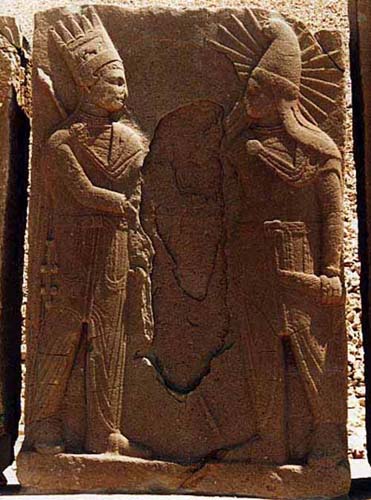
-Antiochus de Commagène et Mithra
Antiochus, vêtu d’un vêtement richement décoré avec une tiare sur la tête, tend son r.h. à Mithra. Il porte un poignard court à son côté et tient un sceptre dans son L.H. Mithra porte un vêtement similaire avec seulement cette différence, qu’il porte un Bonnet phrygien avec deux rubans pendants, couvrant ses oreilles. Autour de la tête, un nimbe et une couronne à 21 rayons. L’habillement se compose d’une cuirasse et d’un manteau, fixé à l’avant par un péroné rond. Sous la cuirasse une longue tunique, qui est maintenu entre les jambes avec des sangles ou des ficelles pour faciliter la marche. Autour le cou un collier. Mithra étend son droit à Antiochus et a un paquet de brindilles (baresman) dans sa main gauche. Leurs pieds sont chaussés.
https://www.tertullian.org/rpearse/mithras/display.php?page=cimrm30
-Shapur I Valérian Bas Relief à Naghsh-e Rostam, Shiraz, Iran.
Bas-relief de l’empereur romain Philippe l’Arabe agenouillé devant Shapur Ier. L’empereur Valérien se tient à l’arrière-plan et est retenu captif par Shapur.
https://en.wikipedia.org/wiki/File:Shapur_I_Valerian_Bas_Relief.jpg
-Valérien
https://fr.wikipedia.org/wiki/Val%C3%A9rien
︵‿︵‿︵‿︵‿︵‿︵‿︵‿︵‿︵‿︵‿︵
✍ENGLISH
Photos:
-Antiochus of Commagene and Mithra
Antiochus, in richly decorated attire with a tiara on his head, holds out his r.h. to Mithras. He carries a short dagger at his side and holds a sceptre in his l.h. Mithras wears a similar attire with only this difference, that he wears a Phrygian cap with two hanging ribbons, covering his ears. Around the head a nimbus and a crown with 21 rays. The attire consists of a cuirass and a cloak, fastened in front with a round fibula. Beneath the cuirass a long tunica, which is held up between the legs with straps or strings to facilitate walking. Around the neck a necklace. Mithras extends his r.h. to Antiochus and has a bundle of twigs (baresman) in his left. Their feet are shod.
https://www.tertullian.org/rpearse/mithras/display.php?page=cimrm30
-Shapur I Valerian Bas Relief at Naghsh-e Rostam, Shiraz, Iran.
A bas relief of Roman Emperor Philip the Arab kneeling down before Shapur I. Emperor Valerian is standing at the background and is held captive by Shapur.
https://en.wikipedia.org/wiki/File:Shapur_I_Valerian_Bas_Relief.jpg
-Valerian (emperor)
https://en.wikipedia.org/wiki/Valerian_%28emperor%29
─────

Photos:
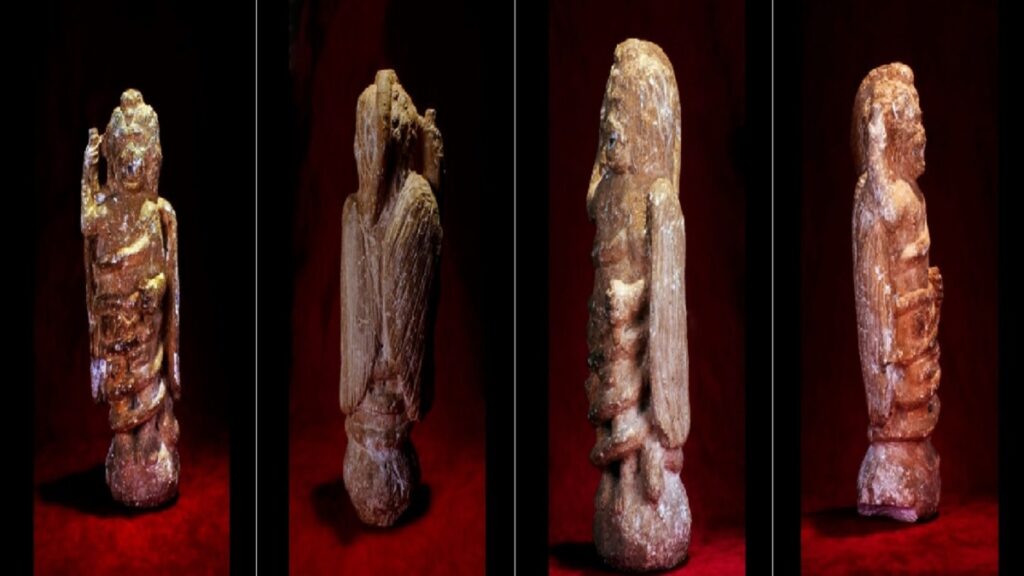
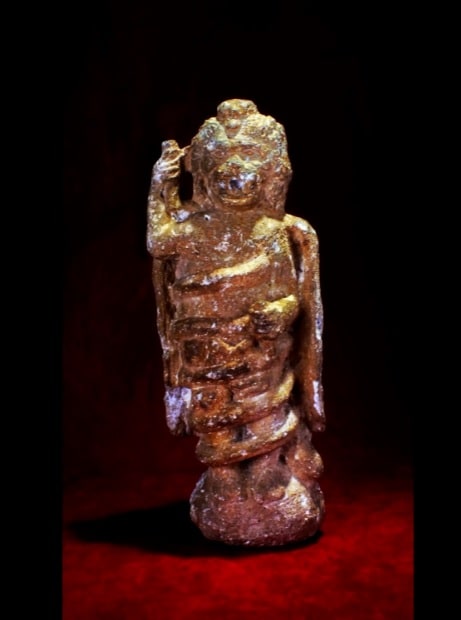
Ariamanus : l’esprit maléfique de la religion mithriaque
La figure principale est une figure léontocéphale nue debout avec seulement un pagne à l’avant et deux ailes fermées à l’arrière ; De face, les ailes apparaissent comme un manteau autour de la figure, mais il s’agit clairement d’ailes, appartenant probablement à un aigle.
Un serpent, attaché autour des chevilles du personnage et remontant jusqu’à sa poitrine en cinq plis et à travers son dos, pose finalement sa tête sur la tête du lion. La figure léontocéphale tient un objet cylindrique dans sa main droite, qui est soulevée au-dessus de l’épaule et repliée sur elle pour reposer l’extrémité de l’objet sur l’épaule droite, et est également artistiquement reliée à la tête pour supporter le poids du bras et de l’objet cylindrique. La main gauche de la figure repose sur ce qui semble être la poignée d’une épée sur le côté gauche de la figure, bien que le fourreau réel ne soit pas visible, disparaissant dans les plis du serpent. À l’arrière, en dessous de l’endroit où les ailes du monstre se rencontrent, il y a un trou qui suggère qu’il a été accroché à un mur ou à une étagère par l’arrière.
Sinon, la statue est en très bon état et constitue un nouvel ajout à la typologie iconographique de la bête, qui est connue du courant religieux mithriaque dans le monde romain et méditerranéen et peut-être dans le Caucase.
https://allinnet.info/antiquities/ariamanus-the-evil-spirit-of-mithraic-religion/#google_vignette
︵‿︵‿︵‿︵‿︵‿︵‿︵‿︵‿︵‿︵‿︵
✍ENGLISH
Photos:
Ariamanus: The Evil Spirit of Mithraic Religion
The main figure is a standing, naked leontocephaline figure with only a loin cloth in the front and two closed wings on the back; from the front, the wings appear as a mantle around the figure, but they are clearly wings, probably belonging to an eagle.
A serpent, bound around the figure’s ankles and continuing up to his chest in five folds and through his back, finally rests its head on top of the lion’s head. The leontocephaline figure holds a cylindrical object in his right hand, which is raised above the shoulder and folded over it to rest the end of the object on the right shoulder, and is also artistically connected to the head to support the weight of the arm and the cylindrical object.
The left hand of the figure rests on what appears to be the handle of a sword on the left side of the figure, although the actual scabbard is not visible, disappearing into the folds of the serpent. At the back, below where the wings of the monster meet, there is a hole which suggests it was hooked to a wall or a shelf from the back.
Otherwise, the statue is in very good condition and a new addition to the iconographic typology of the beast, which is known from the Mithraic religious current in the Roman and the Mediterranean world and perhaps the Caucasus.
https://allinnet.info/antiquities/ariamanus-the-evil-spirit-of-mithraic-religion/#google_vignette
─────

(✍ENGLISH below the French text)
Mithradate VI, l’énigmatique Roi empoisonné
Mithridate est l’attestation grecque du nom persan Mihrdāt, qui signifie « donnée par Mithra », le nom de l’ancien Dieu iranien du Soleil. Le nom lui-même est dérivé du vieil iranien Miθra-dāta.
Mithradate VI est né dans le Royaume du Pont vers 132 av. J.-C., ou vers 135 av. J.-C., en tant que fils aîné du roi Mithridate V, d’ascendance iranienne, et de Laodicé VI, une princesse séleucide. Il hérita d’un riche royaume à l’âge de quatorze ans après que sa mère ait empoisonné son père. Il règne sur le Pont de 120 av. J.-C. à 63 av. J.-C. et sur le Bosphore de 108 av. J.-C. à 63 av. J.-C.
Mithradate VI défia la puissance de la Rome tardive. Il est détesté par Rome pour son massacre de 80 000 civils romains en 88 av. J.-C., mais salué par les Grecs et les Perses comme un « sauveur » de la mauvaise gouvernance oppressive des Romains.
Mithradate VI acquit une parfaite connaissance des poisons et de leurs antidotes afin de s’en préserver. Selon la légende, il serait parvenu à s’immuniser en absorbant de petites doses de poison, processus nommé mithridatisation.
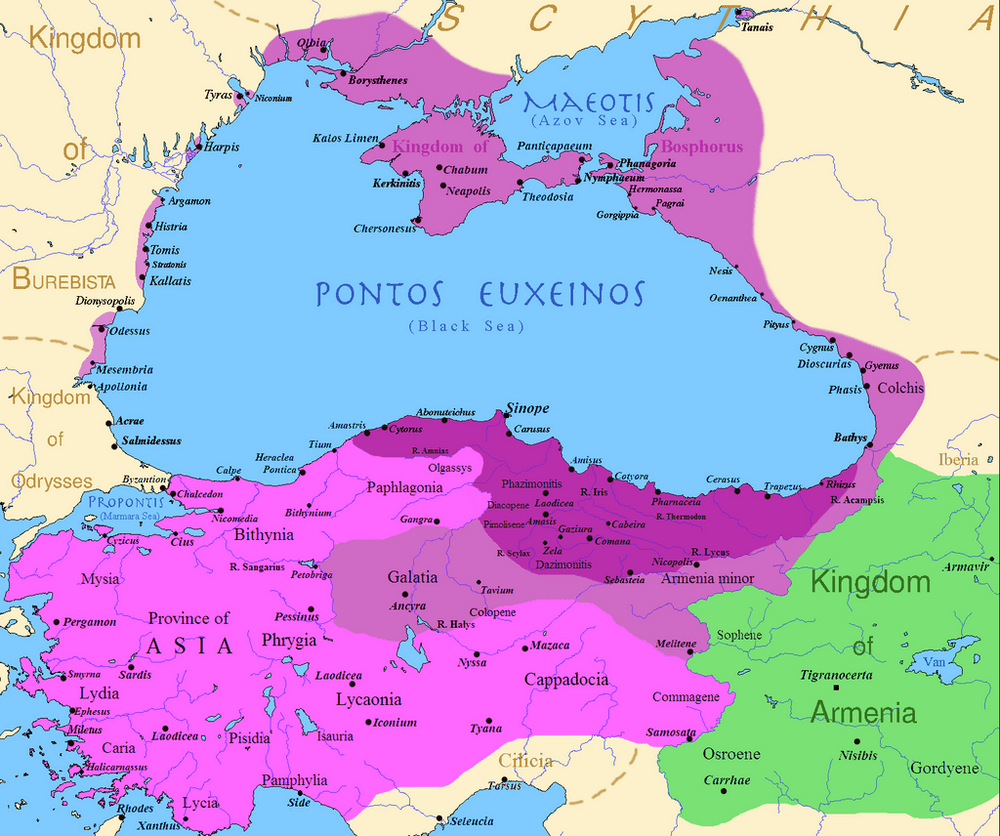
Photo:
Le royaume du Pont avant le règne de Mithridate (violet foncé), avec ses conquêtes avant (violet) et pendant la première guerre mithridatique (rose).
https://fr.wikipedia.org/wiki/Mithridate_VI
Photo:
Portrait du roi du Pont Mithridate VI sous les traits d’Héraclès. Marbre, époque romaine impériale (Ier siècle). Musée du Louvre.
https://collections.louvre.fr/ark:/53355/cl010276237
-Le Roi du Poison
La vie et la légende de Mithradate, l’ennemi le plus mortel de Rome
Le Roi Poison décrit une vie débordante de spectacle et d’excitation.
Revendiquant Alexandre le Grand et Darius de Perse comme ancêtres, Mithradate hérita d’un riche royaume de la mer Noire à l’âge de quatorze ans après que sa mère ait empoisonné son père.
Il s’enfuit en exil et revint triomphant pour devenir un souverain d’une intelligence superbe et d’une ambition féroce.
Salué comme un sauveur par ses partisans et craint comme un second Hannibal par ses ennemis, il envisageait un grand empire oriental pour rivaliser avec Rome.
Après avoir massacré quatre-vingt mille citoyens romains en 88 av. J.-C., il s’empara de la Grèce et de l’actuelle Turquie.
Livrant certaines des batailles les plus spectaculaires de l’histoire antique, il entraîna Rome dans une longue série de guerres et menaça d’envahir l’Italie elle-même.
Son étrange capacité à échapper à la capture et à revenir après des pertes dévastatrices a déconcerté les Romains, tandis que sa maîtrise des poisons lui a permis de déjouer les tentatives d’assassinat et d’éliminer ses rivaux.
https://www.academia.edu/84136373/The_Poison_King_the_life_and_legend_of_Mithradates_Romes_deadliest_enemy
-La mithridatisation est le fait d’ingérer des doses croissantes d’un produit toxique afin d’acquérir supposément une insensibilité ou une résistance vis-à-vis de celui-ci.
Le mot a pour origine le roi du Pont, Mithridate VI (132 av. J.-C. – 63 av. J.-C.) qui, craignant pour sa vie, voulut acquérir une connaissance parfaite des poisons et de leurs antidotes afin de s’en préserver.
Selon la légende, il serait parvenu à s’immuniser en absorbant de petites doses de poison.
Battu par Pompée, il aurait voulu se donner la mort en s’empoisonnant, mais ne put mourir qu’en se faisant tuer par un mercenaire galate.
https://fr.wikipedia.org/wiki/Mithridatisation
-Les réseaux de Mithridate [article]
La première illustration des réseaux autour de Mithridate est sa propre généalogie. Les rois du Pont, et Mithridate en particulier, s’ enorgueillissaient de l’ union entre le sang des Grecs et des Perses.
La dynastie mithridatide descendait des anciens satrapes de Daskyleion, dans la Propontide, qui avaient établi autour de leur cour tout un réseau de contacts gréco-perses.
https://www.persee.fr/doc/dha_0755-7256_2018_num_44_1_4633
︵‿︵‿︵‿︵‿︵‿︵‿︵‿︵‿︵‿︵‿︵
✍ENGLISH
Mithridates VI, the enigmatic poison King
Mithridates is the Greek attestation of the Persian name Mihrdāt, meaning « given by Mithra », the name of the ancient Iranian Sun God. The name itself is derived from Old Iranian Miθra-dāta.
Mithradates VI was born in the Kingdom of Pontus around 132 BC, or around 135 BC, as the eldest son of King Mithridates V, of Iranian descent, and Laodicea VI, a Seleucid princess. He inherited a rich kingdom at the age of fourteen after his mother poisoned his father. He reigned over Pontus from 120 BC to 63 BC and over the Bosphorus from 108 BC to 63 BC.
Mithradates VI challenged the power of late Rome. He was hated by Rome for his massacre of 80,000 Roman civilians in 88 BC, but hailed by the Greeks and Persians as a « savior » from oppressive Roman misrule.
Mithradate VI acquired a perfect knowledge of poisons and their antidotes in order to protect himself. According to legend, he managed to become immune by absorbing small doses of poison, a process known as mithridatization.
Photo:
Map of the Kingdom of Pontus before the reign of Mithridates VI (dark purple), after his conquests (purple), and after his conquests in the First Mithridatic War (pink), including Pontus’ ally the Kingdom of Armenia (green).
https://en.wikipedia.org/wiki/Mithridates_VI_Eupator
Photo:
Portrait of the king of Pontus Mithridates VI as Heracles. Marble, Roman imperial period (1st century). Louvre Museum.
https://collections.louvre.fr/ark:/53355/cl010276237
-The Poison King
The Life and Legend of Mithradates, Rome’s Deadliest Enemy
The Poison King describes a life brimming with spectacle andexcitement.
Claiming Alexander the Great and Darius of Persia asancestors, Mithradates inherited a wealthy Black Sea kingdom atage fourteen after his mother poisoned his father.
He fled into exileand returned in triumph to become a ruler of superb intelligenceand fierce ambition.
Hailed as a savior by his followers and feared asa second Hannibal by his enemies, he envisioned a grand Easternempire to rival Rome.
After massacring eighty thousand Romancitizens in 88 BC, he seized Greece and modern-day Turkey.
Fightingsome of the most spectacular battles in ancient history, he dragged Rome into a long round of wars and threatened to invade Italyitself.
His uncanny ability to elude capture and surge back afterdevastating losses unnerved the Romans, while his mastery of poi-sons allowed him to foil assassination attempts and eliminate rivals.
https://www.academia.edu/84136373/The_Poison_King_the_life_and_legend_of_Mithradates_Romes_deadliest_enemy
-Mithridatism is the practice of protecting oneself against a poison by gradually self-administering non-lethal amounts.
The word is derived from Mithridates VI, the King of Pontus, who so feared being poisoned that he regularly ingested small doses, aiming to develop immunity.
https://en.wikipedia.org/wiki/Mithridatism
-MITHRIDATES VI
Mithridates’ ancestors may well have been an offshoot of the Achaemenid royal family (Bosworth and Wheatley, 1998). They were certainly Iranian nobility who took part in the Persian colonization of Asia Minor, and in the 5th and 4th centuries BCE ran a fiefdom on the shore of the Propontis (the Sea of Marmara) and western end of the south coast of the Black Sea.
https://www.iranicaonline.org/articles/mithridates-vi-eupator-dionysos#prettyPhoto
─────

(✍ENGLISH below the French text)
Champignons, mythe et Mithra: Le culte de la drogue qui a civilisé l’Europe
Les données anthropologiques suggèrent depuis longtemps que les plantes psychédéliques jouent un rôle important dans les communautés indigènes depuis des milliers d’années, mais la plupart des études n’abordent pas la sphère d’influence plus large qu’elles exercent sur la culture occidentale.
Dans ce livre, Mushrooms, Myths & Mithras, le spécialiste des lettres classiques Carl Ruck et ses amis révèlent des preuves irréfutables suggérant que la consommation de champignons psychédéliques était tout aussi influente au début de l’Europe, où elle était au cœur des cérémonies d’initiation de l’élite romaine.
Grâce à l’art et à l’archéologie, nous découvrons que Néron a été le premier empereur à être initié par des « dîners magiques » secrets, et que la plupart de ses successeurs ont adopté le rituel et son utilisation sacramentelle du champignon psychédélique comme source de transcendance spirituelle.
La religion secrète a été officiellement interdite après la conversion romaine, mais certains aspects de ses pratiques ont été assimilés ou cooptés par le christianisme et ont influencé de nombreuses sociétés secrètes ultérieures, y compris les francs-maçons.
Mushrooms, Myths & Mithras est une exploration historique fascinante d’une force puissante qui est restée cachée dans les coulisses pendant des milliers d’années.
-Champignons, mythe et Mithra. Le culte de la drogue qui a civilisé l’Europe
https://www.mithraeum.eu/book/mushrooms-myth-and-mithras-2011
-Champignons, mythe et Mithra : le culte de la drogue qui a civilisé l’Europe
Ce livre illustré retrace l’histoire d’une force improbable dans la formation de la civilisation occidentale: l’utilisation de champignons psychédéliques, notamment par une société secrète appelée le culte de Mithra.
Néron a été le premier empereur à être initié par les « dîners magiques » du groupe, et la plupart de ses successeurs ont adopté le rituel comme une source de transcendance spirituelle.
Le culte a été officiellement interdit après la conversion, mais certains aspects de leurs rituels ont été assimilés ou cooptés par le christianisme, et les confréries persistent aujourd’hui en tant que sociétés secrètes telles que les francs-maçons.
Il s’agit d’une exploration fascinante d’une force puissante gardée dans les coulisses depuis des milliers d’années.
https://www.academia.edu/44304536/Mushrooms_Myth_and_Mithras_The_Drug_Cult_that_Civilized_Europe
︵‿︵‿︵‿︵‿︵‿︵‿︵‿︵‿︵‿︵‿︵
✍ENGLISH
Mushrooms, Myth and Mithras: The Drug Cult that Civilized Europe
Anthropological evidence has long suggested that psychedelic plants have played important roles in indigenous communities for thousands of years, but most scholarship does not address their larger sphere of influence on western culture.
In this book, Mushrooms, Myths & Mithras, classics scholar Carl Ruck and friends reveal compelling evidence suggesting that psychedelic mushroom use was equally influential in early Europe, where it was central to initiation ceremonies for the Roman elite.
Through art and archeology, we discover that Nero was the first Emperor to be initiated by secret « magical dinners, » and that most of his successors embraced the ritual and its sacramental use of the psychedelic mushroom as a source of spiritual transcendence.
The secret religion was officially banned after Roman Conversion, but aspects of its practices were assimilated or co-opted by Christianity, and have influenced many subsequent secret societies, including the Freemasons.
Mushrooms, Myths & Mithras is a fascinating historical exploration of a powerful force kept hidden behind the scenes for thousands of years.
-Mushrooms, Myth & Mithras. The Drug Cult That Civilized Europe
https://www.mithraeum.eu/book/mushrooms-myth-and-mithras-2011
-Mushrooms, Myth & Mithras The Drug Cult that Civilized Europe
This illustrated book traces the history of an unlikely force in the shaping of Western civilization: the use of psychedelic mushrooms, namely by a secret society called the cult of Mithras.
Nero was the first emperor to be initiated by the group’s “magical dinners,” and most of his successors embraced the ritual as a source of spiritual transcendence.
The cult was officially banned after the Conversion, but aspects of their rituals were assimilated or co-opted by Christianity, and the brotherhoods persist today as secret societies such as the Freemasons.
This is a fascinating exploration of a powerful force kept behind the scenes for thousands of years.
https://www.academia.edu/44304536/Mushrooms_Myth_and_Mithras_The_Drug_Cult_that_Civilized_Europe
─────
IranPersiaVoyage
─────
 Iran Persia Voyage